
Sorry, nothing in cart.
Blog

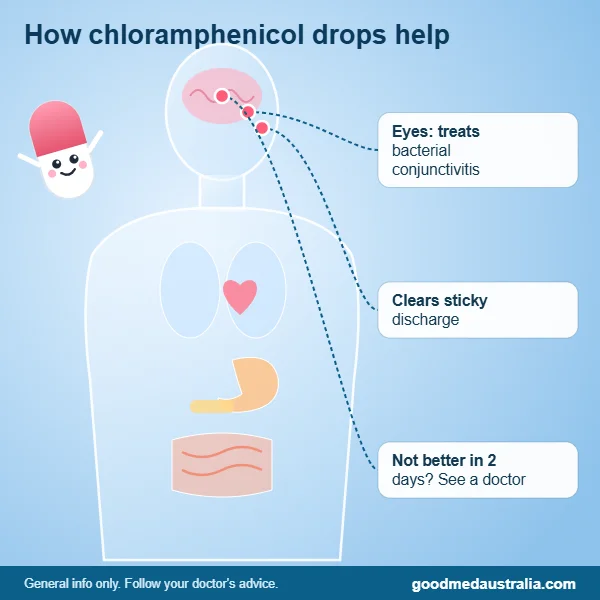
You wake up with one eye red, gritty and stuck shut with yellow crust. Your first thought is probably to get something from the pharmacy. In Australia, that often means chloramphenicol eye drops. They are one of the few antibiotics people can get without a prescription, but they only suit one kind of red eye, and that is where most confusion starts.
What chloramphenicol eye drops are approved for
Chloramphenicol 0.5% eye drops are approved in Australia as a broad-spectrum topical antibiotic for superficial eye infections, specifically bacterial conjunctivitis. The approval covers adults and children aged 2 years and over.
The symptom pattern that points towards a bacterial cause includes:
- sticky, yellow-white (purulent) discharge
- eyelids stuck together on waking
- a gritty feeling in the eye
- redness
Brand names such as Chlorsig appear on Australian consumer medicine information, but the active ingredient is the same. A pharmacist or doctor can tell you which product you are looking at.
Why the cause of a red eye matters
Chloramphenicol works against bacteria. It does nothing for viral conjunctivitis, such as adenovirus, or for allergic conjunctivitis. These causes make up a significant share of red-eye cases, and from the outside they can look much like a bacterial infection.
Consider two illustrative situations. In the first, someone has thick yellow discharge and eyelids glued shut each morning. That fits the pattern the drops are approved for. In the second, someone has itchy, watery, red eyes every spring. That pattern is more typical of allergy, and an antibiotic would not be expected to help. Self-diagnosis is risky for this reason, particularly if the real cause is viral or fungal.
How you get them in Australia
For bacterial conjunctivitis in adults and children aged 2 and over, chloramphenicol eye drops are a Schedule 3 (Pharmacist Only) medicine. You can obtain them without a doctor’s prescription, but only after a consultation with a pharmacist. That conversation is a safety step. The pharmacist can check your symptoms, ask about contact lenses, pregnancy or other medicines, and tell you if you should see a doctor or optometrist instead.
Safety and side effects
The common side effects are minor and short-lived: stinging or burning when the drops go in, and brief blurred vision afterwards.
The rarer concern is historical. Chloramphenicol was first isolated in 1947 from the soil bacterium Streptomyces venezuelae and synthesised in 1949. It was the first synthetic broad-spectrum antibiotic. Mid-20th-century doctors used it by mouth and by injection for severe infections such as typhoid fever, bacterial meningitis, cholera and typhus. Systemic use was later phased out in many countries because of serious toxicities, including aplastic anaemia, bone marrow suppression and grey baby syndrome. Its everyday use shifted mainly to eye drops.
The research notes that absorption into the body from eye drops is minimal compared with oral use. Even so, product information still carries warnings about extremely rare blood disorders linked to topical use. The sensible reading is that the risk from drops is much lower than the old oral warnings suggest, but not zero. This is another reason to talk to a pharmacist first, especially if you are pregnant or breastfeeding, as the research here gives no specific guidance for those situations.
Handling, storage and contact lenses
Practical details matter with this medicine:
- Storage: unopened bottles generally need refrigeration at 2°C to 8°C. Once opened, protect the container from light and discard it after 4 weeks.
- Contact lenses: remove them before using the drops and do not wear them for the whole treatment period. Wait at least 24 hours after finishing before wearing them again. Many people remember the first part and miss the waiting period.
- Reducing absorption: gently pressing the inner corner of the eye (over the tear duct) for 1 to 2 minutes after the drops go in reduces how much drug is absorbed into the body. Ask your pharmacist to show you the technique.
Always follow the directions on the product label and from your pharmacist or doctor, since this article does not give dosing.
Approved use, traditional use and early research
It helps to keep the different kinds of evidence apart.
| Category | What it covers |
|---|---|
| Approved use | Chloramphenicol 0.5% eye drops for bacterial conjunctivitis in adults and children aged 2 and over; Schedule 3 pharmacist-only access in Australia. |
| Traditional or historical use | Oral and intravenous use from the mid-20th century for severe systemic infections, later phased out in many countries because of serious toxicity. |
| Early research and mechanism | Laboratory work showing it inhibits bacterial protein synthesis by binding the 50S ribosomal subunit, and early studies of how much is absorbed from eye drops. |
The mechanism is worth a line. Chloramphenicol is bacteriostatic: it reversibly blocks protein production in susceptible Gram-positive and Gram-negative bacteria, which stops them multiplying. That is background science rather than a promise of outcome for any individual.
When to get medical advice
Seek prompt review from a doctor or optometrist if you have eye pain, sensitivity to light or changes in your vision. Also get checked if symptoms have not improved within 48 hours. These signs suggest the problem may be something other than simple bacterial conjunctivitis.
Frequently asked questions
Can I use chloramphenicol for any red eye?
No. It is approved for bacterial conjunctivitis. It is not effective against viral or allergic conjunctivitis.
Do I need a prescription?
Not for bacterial conjunctivitis in adults and children aged 2 and over, but you must speak to a pharmacist first because it is a Schedule 3 medicine.
Why are the drops kept in the fridge?
Unopened bottles generally need storage at 2°C to 8°C. After opening, protect the bottle from light and discard it after 4 weeks.
Can I wear contact lenses?
Not during treatment, and not for at least 24 hours afterwards.
Are the old warnings about aplastic anaemia relevant to eye drops?
They come from oral and systemic use. Absorption from eye drops is minimal in comparison, though product information still lists extremely rare blood disorders. Raise any concerns with your pharmacist or doctor.
Conclusion
Chloramphenicol eye drops have a narrow, well-defined approved use: bacterial conjunctivitis in people aged 2 and over. Getting the cause right matters as much as the drops themselves, because viral and allergic red eyes will not respond. Storage, contact lens rules and the 48-hour check-in point are easy to overlook but important. If your eye is red and sticky, speak to a pharmacist, doctor or optometrist before using any medicine, and seek urgent review if pain, light sensitivity or vision changes appear.
This article is for general education only and is not a substitute for personal medical advice. Always consult a registered doctor, optometrist or pharmacist.
Find more trusted, plain-English health guides at goodmedaustralia.com.