
Sorry, nothing in cart.
Blog

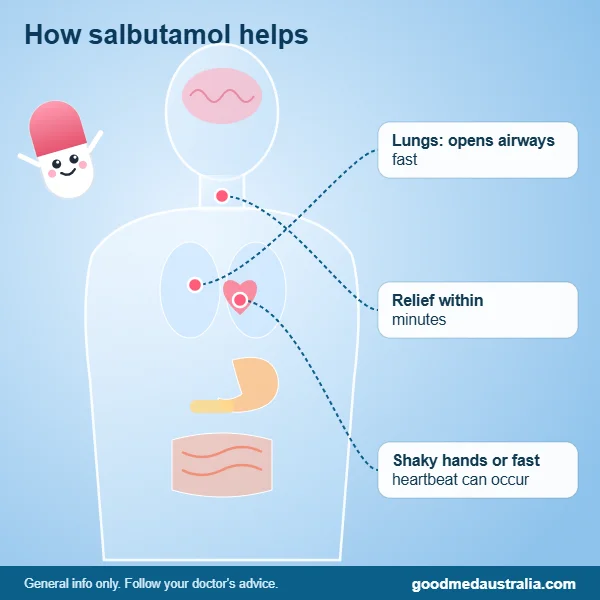
You take two puffs of your reliever, your breathing eases, and then your hands start to tremble and your heart feels like it’s pounding. If that has ever worried you, you’re not alone. Shakiness and a racing pulse are among the most commonly reported reactions to salbutamol (called albuterol in some countries, and sold in Australia under brand names such as Ventolin). Understanding why they happen makes it easier to tell what is expected from what needs attention.
What salbutamol is, and what it is approved for
Salbutamol is a short-acting beta-2 agonist (SABA), a type of bronchodilator. In Australia it is approved for rapid relief of airway constriction in asthma, chronic obstructive pulmonary disease (COPD) and exercise-induced bronchospasm.
It helps to be clear about the other categories, because they are often blurred online:
- Proven, approved use: quick relief of airway tightening, as described above.
- Hospital and investigative use: in hospital, high-dose or intravenous salbutamol is used under strict monitoring as an add-on treatment for acute hyperkalaemia (dangerously high blood potassium). This is a clinical decision made by a medical team and is not something for home use. Research also continues into combination approaches, such as pairing a reliever with an inhaled corticosteroid, to reduce the risks of relying on a reliever alone.
- Traditional use: none. Salbutamol is a synthetic pharmaceutical developed in the late 1960s, with no herbal or traditional medicine background.
Why a lung medicine makes your hands shake
Salbutamol is designed to stimulate beta-2 receptors in the airways, which helps them open. But a small amount is absorbed into the bloodstream, and beta-2 receptors are also found in skeletal muscle. Stimulating them there can cause the fine tremor many people notice in their hands.
The same absorbed medicine can act on beta receptors in the heart, which is why your pulse may rise or you may feel palpitations. Other commonly listed effects include headache and feeling nervous or edgy. So the shakiness is not a sign that something has gone wrong with the puffer. It is the medicine acting on tissues other than the lungs.
How long do the effects last?
Mild side effects usually begin within minutes to about 30 minutes of inhaling and tend to peak within the first hour. They typically fade over two to four hours as the liver and kidneys clear the drug. Salbutamol’s elimination half-life is roughly four to six hours.
In practice, if your hands feel unsteady after a dose, you can expect it to settle through the afternoon rather than linger into the next day. If the effects are lasting much longer, or getting stronger instead of easing, that is worth raising with a doctor or pharmacist.
Puffer with spacer versus nebuliser
How the medicine is delivered affects how much of it ends up in your bloodstream. Australian clinical guidelines, including those from the National Asthma Council Australia, recommend a pressurised metered-dose inhaler (pMDI) with a spacer over a nebuliser where possible.
| Delivery method | What to know |
|---|---|
| Puffer (pMDI) with spacer | Generally preferred in guidelines. Good technique reduces the amount of medicine swallowed and absorbed into the bloodstream, which helps limit side effects. |
| Nebuliser | Delivers a higher total systemic dose, which can increase effects outside the lungs, such as stronger tremor, a faster heart rate and anxiety. |
If you often feel very shaky, ask your pharmacist or GP to check your inhaler and spacer technique. It is a simple step that is easy to overlook.
Frequent shakiness can be a clue about asthma control
Many articles treat shakiness as a nuisance to put up with. The more useful question is how often you need the reliever in the first place.
Australian guidance, as summarised by Healthdirect, treats frequent reliever use as a sign that asthma is not well controlled. Examples include needing it more than two to three days a week, or going through three or more canisters in a year. If that sounds familiar, the answer is usually a medical review to consider introducing or adjusting a daily preventer medication, not simply tolerating the tremor.
A few practical situations that suggest it is time to book a review:
- You reach for your puffer most weeks, and the shakiness has become routine.
- You notice you are replacing canisters more often than you used to.
- You don’t have a written Asthma Action Plan, or yours is out of date.
Please don’t change or stop any prescribed medicine without talking to your doctor first.
When side effects are not just a nuisance
Mild tremor and a faster pulse that settle within a few hours are generally what people expect. Seek medical help promptly if you experience:
- severe chest pain
- extreme dizziness
- signs of an allergic reaction
If symptoms are severe or you are struggling to breathe, call triple zero (000). The consumer medicine information (CMI) that comes with your medicine, which is regulated by the TGA, lists reactions in more detail, and your pharmacist can walk you through it.
Frequently asked questions
Is a racing heart after salbutamol normal?
A temporarily faster pulse or palpitations are recognised effects, because absorbed salbutamol stimulates beta receptors in the heart. If it is severe, comes with chest pain or extreme dizziness, or doesn’t settle, get medical advice promptly.
Are side effects worse with a nebuliser?
They can be. Nebulisers deliver a higher total systemic dose than a puffer with a spacer, which can mean stronger tremor, a faster heart rate and more anxiety.
How long should shakiness last?
Usually two to four hours, with effects starting within minutes to 30 minutes and peaking within the first hour.
Is salbutamol a natural or herbal remedy?
No. It is a synthetic medicine developed in the late 1960s and has no traditional use.
Should I just put up with the shakiness if I use my puffer a lot?
Not without a review. Frequent use suggests asthma may be under-treated, and a doctor can assess whether a preventer is needed.
The takeaway
Shakiness and a quicker heartbeat after salbutamol are explainable: the medicine reaches muscle and heart receptors as well as the airways, and the effects usually pass within a few hours. What deserves attention is the pattern. Frequent reliever use, heavy side effects or unusual symptoms are reasons to speak with your GP or pharmacist, who can check your technique, review your Asthma Action Plan and advise on your options. This article is general education and not a substitute for personal medical advice.
Find more trusted, plain-English health guides at goodmedaustralia.com.