
Sorry, nothing in cart.
Blog

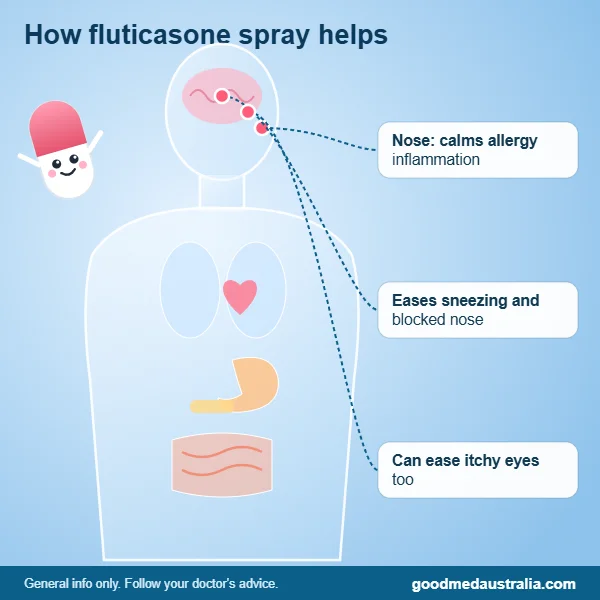
You wake up sneezing, your nose is blocked, and the antihistamine you took last week did little for the congestion. A friend suggests a steroid nose spray, and now you’re wondering what it does, whether it’s safe to use daily and whether you need a script. These are the questions people most often ask about fluticasone nasal spray in Australia, and the answers are mostly straightforward once you know how this type of medicine works.
This article is general information only. It isn’t personal medical advice, so speak to a doctor or pharmacist about your own situation.
What fluticasone nasal spray is
Fluticasone propionate is a synthetic corticosteroid (a glucocorticoid) developed in the late 20th century. It is a modern pharmaceutical, so it has no traditional or herbal history. It is also a different kind of medicine from the anabolic steroids associated with bodybuilding, and different again from decongestant sprays.
Because it is sprayed into the nose, it acts directly on inflamed nasal tissue. That is why intranasal corticosteroids are considered first-line treatment for moderate-to-severe allergic rhinitis, according to the National Asthma Council Australia.
Proven, early and traditional: keeping the categories clear
Approved uses
The Therapeutic Goods Administration (TGA) has approved fluticasone nasal spray for preventing and treating seasonal allergic rhinitis (hay fever) and perennial allergic rhinitis. This applies to adults and eligible adolescents. Hay fever symptoms include sneezing, a blocked or runny nose and watery eyes.
Early or emerging research
Researchers are looking at several areas beyond standard use. They are not established recommendations.
- Combination sprays: pairing fluticasone with an intranasal antihistamine such as azelastine, aiming for both rapid relief (within about five minutes) and longer-lasting anti-inflammatory effects.
- Specialised delivery systems for chronic rhinosinusitis with nasal polyps.
- Long-term eye safety, including monitoring of eye pressure and cataracts.
Traditional use
None. If you see a product described as a “natural” alternative to fluticasone, it is a different thing altogether, and any claims about it need separate evidence.
Why it doesn’t work like an antihistamine
Many people stop using a steroid spray after a day or two because they expect instant relief, as they might from a decongestant. Fluticasone works as a preventive, building up its anti-inflammatory effect with regular use. Australian Allergy Centre information notes that initial relief may come within 12 to 24 hours, but the best results may take several days of continuous use.
A practical example: if you know your symptoms flare every spring, it makes sense to talk to your pharmacist about starting before the worst of the season rather than waiting until you’re miserable. Someone who tries it once on a bad pollen day and gives up that evening hasn’t really given it a fair trial. A pharmacist can also explain when a faster-acting medicine might be a better fit for a particular day.
Availability in Australia
Some fluticasone propionate products, such as Flixonase Allergy & Hayfever 24 Hour, are Schedule 2 (Pharmacy Medicine). This means adults can get them from a pharmacy without a prescription, for short-to-medium-term use of up to six months, according to Healthdirect Australia.
Scheduling and subsidy details can vary by product and strength, so ask your pharmacist or doctor about prescription-only products and whether any are covered by the Pharmaceutical Benefits Scheme. Even without a prescription, the pharmacist is part of the process. They can check that the spray suits you and that you’re not overlooking something else, such as another medicine or a health condition.
Safety and side effects
The common side effects are local ones: minor nosebleeds, dry or irritated nasal passages, headache, and an unpleasant taste or smell (NHS information). Intranasal fluticasone propionate is absorbed into the bloodstream only in small amounts, less than 2% according to US National Library of Medicine drug labelling. That is why systemic corticosteroid effects are less likely when it is used correctly.
Low absorption doesn’t mean “no questions”. It is sensible to talk to a doctor or pharmacist if you:
- plan to use a spray for a long time;
- have frequent nosebleeds;
- have eye conditions or a family history of them, since long-term eye safety is an active research area;
- are considering it for a child or adolescent.
Spray technique matters
Technique is often overlooked, yet it affects comfort and may affect side effects. Aim the nozzle slightly away from the middle wall of the nose (the septum), towards the outer wall of the nostril. This helps reduce the risk of nosebleeds and irritation to the septum. If the spray is aimed straight up or inward, the same spot gets hit repeatedly.
If you’re unsure, ask your pharmacist to show you. It takes a minute and often prevents problems.
The hay fever and asthma connection
If you have asthma, hay fever deserves attention. Poorly controlled allergic rhinitis is linked with worse asthma control, and the National Asthma Council Australia discusses the two conditions together. If your nose symptoms are flaring and you’re also wheezing more or using your reliever more often, mention both to your doctor rather than treating them separately.
Frequently asked questions
Is fluticasone nasal spray the same as a decongestant spray?
No. Decongestant sprays are used for quick relief, whereas fluticasone is a corticosteroid that works through regular use over several days. Questions about rebound congestion usually relate to decongestant sprays, so ask your pharmacist how the two types differ.
Can I buy it without a prescription?
Some formulations are Schedule 2 (Pharmacy Medicine) and are available from pharmacies for adults without a prescription. Your pharmacist can confirm which products are suitable.
How soon will I notice a difference?
Some people notice an effect within 12 to 24 hours, but the full benefit may take several days of regular use.
Is it a “natural” or traditional remedy?
No. It is a synthetic corticosteroid with no traditional or herbal background.
The bottom line
Fluticasone nasal spray is an approved, well-established option for seasonal and perennial allergic rhinitis in adults and eligible adolescents, and its value lies in steady use rather than instant relief. Side effects are usually local, and good technique helps. Newer combinations and delivery methods are still being researched. Before you start, change or stop any nasal spray, speak to your doctor or pharmacist, especially if you have asthma, eye concerns or symptoms that don’t settle.
Find more trusted, plain-English health guides at goodmedaustralia.com.