
Sorry, nothing in cart.
Blog

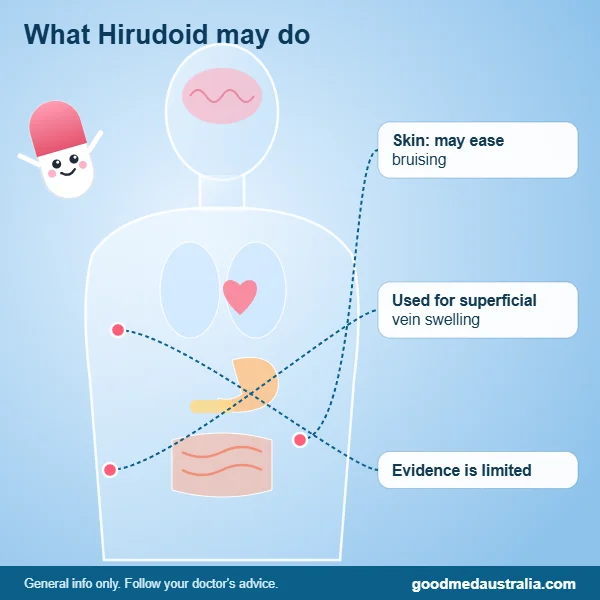
A bruise on the shin from a coffee table, or a tender, firm line along a vein in the leg: both send people to the pharmacy shelf looking for something that might help. Hirudoid is one of the better-known names. What it does, what it has been approved for and what is still being studied are often blurred together. This article separates them, so you know what the evidence supports and where a doctor or pharmacist needs to be involved.
What Hirudoid cream is
Hirudoid cream contains a heparinoid, mucopolysaccharide polysulfate. Do not assume it is animal-free; ask the manufacturer about ingredient origin if this matters to you.
Approved uses in Australia
This is the firmest ground. Hirudoid is listed on the Australian Register of Therapeutic Goods (ARTG) as a non-prescription topical medicine for:
- relief of bruises and swelling
- improvement of scar tissue
- support in inflammatory conditions of the superficial veins, under medical supervision
The last point matters. The listing does not describe the cream as something to use alone on a vein problem. The words “under medical supervision” are part of the picture.
Why superficial vein inflammation needs a doctor first
A bruise is usually self-evident. Vein inflammation is not. Superficial thrombophlebitis, inflammation of a vein close to the skin surface, can look similar to other problems, and a doctor needs to rule out a deeper clot such as deep vein thrombosis (DVT). Deeper vein problems are a different matter from a superficial one, and a cream applied to the skin is not a substitute for assessment.
Consider two general examples. A person notices a purple mark on their forearm after bumping a bench: a pharmacist can talk through whether a topical product suits them. Another person has a tender, inflamed vein in the leg, or swelling with no obvious cause. That second situation calls for a medical review before anything is applied.
Safety and limitations
- Intact skin only. Hirudoid is for external use. It should not go on open wounds, large areas of skin, the eyes or mucous membranes.
- Children. Ask a pharmacist whether the exact locally supplied product is suitable for the child’s age.
- Allergy and sensitivity. It should not be used by anyone with known hypersensitivity to MPS or to the formulation’s excipients, which include lanolin, cetostearyl alcohol and parabens. These ingredients can cause allergic contact dermatitis in sensitive people.
- Flammability. Dressings, clothing or bedding that come into contact with topical creams can build up residue, creating a serious burn risk near naked flames. This warning is easy to overlook, and it applies to many skin products, not only this one.
When to speak to a professional
Speak to a doctor or pharmacist before using Hirudoid if you have a vein condition, significant swelling or bruising that has no clear cause. The same applies if skin looks infected or the problem is getting worse. Do not self-diagnose, and do not change a treatment plan your doctor has prescribed.
Is Hirudoid proven to make bruises fade faster?
Bruises and swelling are an approved use in Australia. Small trials suggest faster bruise absorption compared with placebo, but that research is limited, so it is best seen as encouraging rather than conclusive.
Can it be used on a broken or grazed area?
No. It is intended for intact skin only, not open wounds.
Is it a treatment for DVT?
No. Its approved role relates to superficial veins under medical supervision. Suspected deeper vein problems need prompt medical assessment.
Who should avoid it?
Avoid it if allergic to the active ingredient or other ingredients. Ask a pharmacist about suitability for children and check the exact pack leaflet.
Do not treat a suspected clot with cream
One-sided leg swelling, pain or warmth needs urgent medical assessment. Chest pain, sudden breathlessness or coughing blood may indicate a pulmonary embolism: call 000. Do not massage a suspected clot.
Sources and further reading
TGA Hirudoid registration. Check the leaflet matching your exact product; formulations, approved uses and instructions can differ.
Explore more medicine safety guides or read our frequently asked questions.
General education only. This does not replace an individual assessment by a doctor or pharmacist. In an emergency in Australia, call 000.
Find more trusted, plain-English health guides at goodmedaustralia.com.