
Sorry, nothing in cart.
Blog

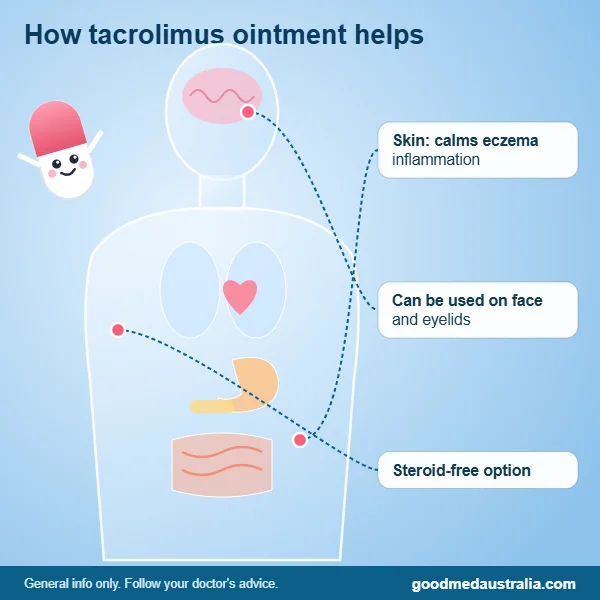
Tacrolimus ointment is a steroid-free prescription option for certain people with moderate to severe eczema. This guide covers local irritation, precautions and the difference between approval and PBS eligibility.
What tacrolimus ointment is, and what it is not
Tacrolimus is a topical calcineurin inhibitor, a non-steroidal immunomodulator. It targets specific immune responses in the skin. Unlike topical corticosteroids, it does not interfere with collagen synthesis, so it avoids the skin-thinning risk linked to continuous steroid use.
It is also not a natural or herbal product. Tacrolimus is a modern pharmaceutical made from the fermentation of a soil bacterium, Streptomyces tsukubaensis. It has no history of traditional use, which is worth stating plainly because some people assume a “steroid-free” cream must be a botanical one.
Why the Australian context matters
Overseas articles often centre on US regulatory warnings and skip the local details. In Australia, tacrolimus ointment is a Schedule 4 (prescription only) medicine. The 0.1% strength is approved from age 16, which is an important detail for parents searching on behalf of younger children.
Formulations such as aZematop 0.1% are listed on the PBS for eligible patients who meet specific criteria under medical supervision. Whether a particular person qualifies is a question for their doctor, not something to assume from a web search.
The burning and stinging question
Transient burning, stinging, itching or redness where the ointment is applied is very common, especially in the first few days. This is partly because the skin barrier is already inflamed when treatment begins.
A practical example: someone starts the ointment on a flared patch of inflamed skin and feels a warm sting within minutes. That reaction is a recognised early effect, and it is worth reporting to the prescriber or pharmacist rather than quietly stopping or pushing through. They can explain what to expect and whether anything about the way the ointment is being used should change. If the reaction is severe or does not settle, get medical advice.
Sun protection in a high-UV country
Topical tacrolimus can increase skin sensitivity to UV radiation. People using it are advised to practise strict sun protection, which means protective clothing and a broad-spectrum SPF 30+ sunscreen. They should also avoid artificial UV light and tanning beds.
Minimise sunlight exposure, use protective clothing and sunscreen, and avoid tanning beds. Ask your pharmacist how to fit skin products around the ointment.
Practical rules that are easy to miss
- Spacing with moisturisers. A commonly cited rule is to leave about two hours between tacrolimus ointment and regular emollients or other topicals on the same area. Check your own timing with your pharmacist, as this is easy to get wrong in a busy routine.
- No occlusive dressings. The ointment should not be used under occlusive bandages or dressings.
- Not on infected skin. It must not be applied to actively infected skin, whether bacterial, viral (such as herpes simplex) or fungal. If a patch looks weepy, crusted or suddenly more painful, see a doctor before applying anything further.
- Rare genetic skin conditions. It should not be used where the skin barrier is broken because of specific rare genetic conditions, such as Netherton syndrome.
Face, eyelids and sensitive skin
Your prescriber decides whether the ointment is appropriate for sensitive areas. Avoid the eyes and mucous membranes, and use it only on the sites specified.
Frequently asked questions
Is tacrolimus ointment a steroid?
No. It is a non-steroidal topical calcineurin inhibitor and works differently from corticosteroid creams.
Can I get it without a prescription?
No. It is a Schedule 4 medicine in Australia, so a prescription is required.
Is it on the PBS?
Some formulations, such as aZematop 0.1%, are PBS-listed for eligible patients who meet specific criteria under medical supervision. Your doctor can tell you whether you qualify.
Can it be used for vitiligo, seborrhoeic dermatitis or psoriasis?
These uses require specialist assessment and are outside the approved eczema indication described here. Off-label use does not automatically mean experimental use.
Do I still need sunscreen?
Yes. The ointment can increase UV sensitivity, so protective clothing and broad-spectrum SPF 30+ sunscreen are advised, and tanning beds should be avoided.
Symptoms to report
Ask for assessment of infected skin, persistent swollen glands or new skin changes. Severe allergic swelling, fainting or breathing difficulty needs emergency care.
Approved use
Australian aZematop 0.1% is indicated for moderate to severe atopic dermatitis from age 16 when conventional treatment is inadequate or not tolerated, with maintenance treatment for selected responders. Other conditions require specialist advice.
Sources and further reading
aZematop CMI. Check the leaflet matching your exact product; formulations, approved uses and instructions can differ.
Explore more medicine safety guides or read our frequently asked questions.
General education only. This does not replace an individual assessment by a doctor or pharmacist. In an emergency in Australia, call 000.
Find more trusted, plain-English health guides at goodmedaustralia.com.