
Sorry, nothing in cart.
Blog

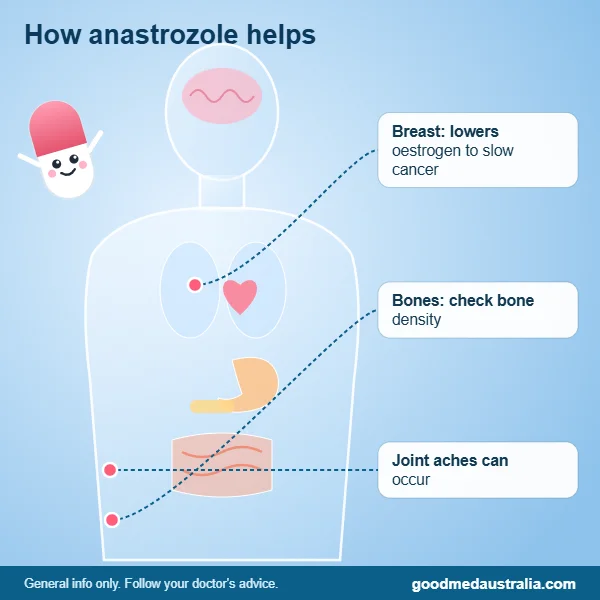
For many women, the hardest part of anastrozole is not the decision to start. It is the months afterwards, when a stiff first step out of bed or a night of hot flushes makes them wonder whether this is normal and whether anything can be done. The short answer is that these effects are well recognised, they follow from how the medicine works, and your care team has options. Here is what the Australian sources say.
Why side effects follow from how anastrozole works
Anastrozole is an aromatase inhibitor used for certain hormone-responsive breast cancers in postmenopausal women. It lowers oestrogen. An oncologist decides whether it is appropriate and how long treatment should continue.
Oestrogen also does other work in the body, including supporting joints and bones. Most of the common side effects trace back to that lower oestrogen level.
Joint pain and stiffness
Joint pain and stiffness are recognised with aromatase inhibitors. Symptoms can affect daily activity and should be discussed with the cancer team; severe or new pain needs assessment rather than being automatically attributed to treatment.
It is easy to dismiss this as “just a bit of pain”, but joint discomfort can affect whether people feel able to keep taking their medication long term. If it is wearing you down, tell your doctor. It is a recognised effect, not a complaint to be tolerated in silence.
Bone health
Oestrogen suppression accelerates bone loss, which raises the risk of osteoporosis and fractures. Cancer Australia notes that clinical guidelines recommend baseline bone mineral density monitoring with a DEXA scan for patients at risk.
Unlike joint pain, bone thinning usually causes no symptoms, so you cannot feel it happening. That is why monitoring matters. Ask your oncologist or GP whether a DEXA scan is appropriate for you, and how often your bone health should be reviewed.
Other common side effects
eviQ and Cancer Australia list a broader range of effects:
- Menopausal symptoms, including hot flushes and night sweats
- Cancer-related fatigue
- Mood changes
- Carpal tunnel symptoms (tingling or numbness in the hand)
- Mild rash
- Nausea
- Cholesterol changes
Not everyone experiences all of these, and some people have very few. Cholesterol changes are not something you would notice, which is another reason regular check-ups matter.
How long do side effects last?
Side effects and their duration vary. Treatment often lasts years, but the plan is individual. Discuss persistent symptoms with your oncology team instead of stopping on your own.
The practical approach is to keep track. A simple note on your phone recording what you felt, when, and how it affected your day gives your doctor something concrete to work with.
Practical ways to approach day-to-day symptoms
These are general supportive ideas, not a treatment plan. Check them with your care team first.
- Gentle morning movement. If stiffness is worst on waking, some people find slow joint mobility exercises before getting going helpful.
- Heat or cold. A warm pack or cold pack on a sore joint draws on long-standing physical therapy practice and may help maintain mobility alongside conventional care.
- Pacing. With fatigue, spreading tasks across the day rather than doing everything in one burst can make it more manageable.
- Physiotherapy. A physiotherapist can tailor movement to your joints and energy levels.
- Bringing it up early. If pain becomes hard to manage, your doctor can explore other management strategies or alternative medications. Do not stop taking anastrozole on your own.
Frequently asked questions
Is joint pain from anastrozole a sign something is wrong?
It is a recognised effect linked to lower oestrogen. Still, new or worsening pain should be reviewed by your doctor, who can check it is related to the medicine.
Do I need a bone density scan?
Guidelines recommend baseline DEXA monitoring for patients at risk. Your GP or oncologist can tell you whether that applies to you.
Can I take vitamin D or supplements for joint pain?
Vitamin D has been studied in small trials, but the evidence is early. Speak to your doctor or pharmacist before adding any supplement.
What if I cannot tolerate it?
Talk to your doctor. They can look at other ways to manage symptoms or consider alternative medications. Do not stop or change your medicine without advice.
Where can I find reliable information?
Cancer Australia, eviQ and Healthdirect are good starting points. Your pharmacist can also provide the TGA Consumer Medicine Information (CMI) leaflet for your brand.
Serious symptoms
Seek urgent assessment for chest pain, sudden breathing difficulty or jaundice. Severe allergic swelling or breathing difficulty is an emergency. Anastrozole must not be used during pregnancy or breastfeeding.
Sources and further reading
Arimidex. Check the leaflet matching your exact product; formulations, approved uses and instructions can differ.
Explore more medicine safety guides or read our frequently asked questions.
General education only. This does not replace an individual assessment by a doctor or pharmacist. In an emergency in Australia, call 000.
Find more trusted, plain-English health guides at goodmedaustralia.com.