
Sorry, nothing in cart.
Blog

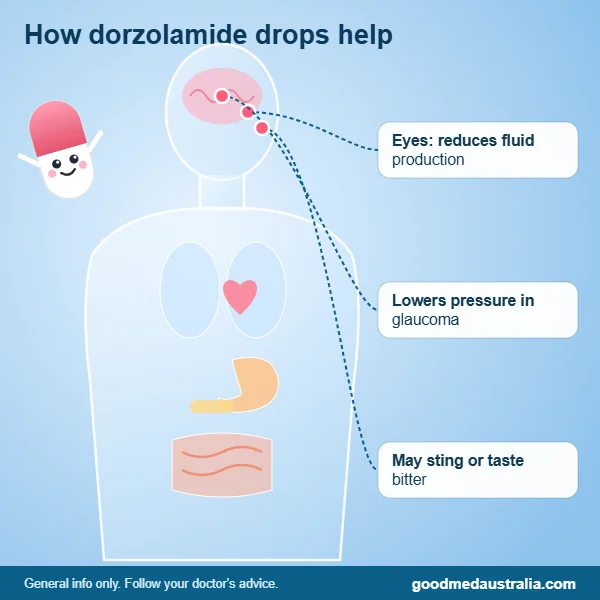
If you’ve been prescribed dorzolamide eye drops, you probably have a few practical questions. What are they for? Why does my mouth taste bitter after using them? Do they matter if I’m allergic to sulfa drugs? This article covers what is established, what is still being researched, and what to raise with your doctor or pharmacist.
What dorzolamide is and how it works
Dorzolamide hydrochloride is a carbonic anhydrase inhibitor (CAI). It acts on enzymes in the ciliary body of the eye to reduce the production of aqueous humour, the fluid inside the eye. Less fluid means lower pressure inside the eye.
In Australia, dorzolamide eye drops are sold under generic names and brands such as Trusopt and Trusamide. They are a Schedule 4 prescription-only medicine on the Australian Register of Therapeutic Goods (ARTG), so you need a prescription from a doctor.
Approved uses in Australia
Dorzolamide eye drops are approved to treat raised intraocular pressure in people with:
- ocular hypertension
- open-angle glaucoma
That is the established, regulator-approved use. Whether it suits a particular person is a decision for their eye specialist or doctor.
Combination drops with timolol
Dorzolamide is also available in fixed-combination drops with timolol, a beta-blocker. Examples include Cosdor and Vizo-PF Dorzolatim. These are approved for people who need more than one medicine to reach their target eye pressure. If you are using a combination product, check the label so you know which active ingredients you are getting. Do not add or swap eye drops without asking your pharmacist.
Common side effects and why they happen
Most reported effects are local, meaning they happen in or around the eye:
- stinging or burning
- itching
- red or watery eyes
- dry eyes
- temporary blurred vision
The bitter taste
Many people notice a bitter taste shortly after using the drops. This is because some of the liquid drains through the nasolacrimal (tear) duct, which connects the inner corner of the eye to the nose and throat. It is commonly reported and usually brief.
Many eye care professionals suggest gentle punctal occlusion. After applying a drop, you close your eye and press lightly on the inner corner, near the nose. This can reduce the taste and lessen how much medicine is absorbed into the rest of the body. Ask your pharmacist to show you the technique so you are confident you’re doing it correctly.
If you develop a rash, swelling, difficulty breathing or any other reaction that seems unusual or severe, seek medical advice promptly.
The sulfa connection many people miss
Dorzolamide contains a sulfonamide structure, so it is related chemically to sulfa medicines. If you have ever had a hypersensitivity reaction to a sulfa drug, tell your doctor or pharmacist before starting. Don’t assume the drops are fine because they go in the eye rather than being swallowed.
It is also worth telling your prescriber about your full health history. People often ask about severe kidney conditions and contact lens use. This article can’t answer those individual questions, but they are exactly the kind of thing your clinician or pharmacist can check against your product’s Consumer Medicine Information (CMI).
Storage and handling
Discard dates depend on the formulation and container. Check the opening-date instructions on your specific pack; do not assume all dorzolamide bottles have the same shelf life.
- writing the opening date on the bottle or box
- checking your product’s leaflet, as formulations differ
- not letting the dropper tip touch your eye or fingers
- asking your pharmacist if you are unsure how to store the bottle
The PBS may cover some dorzolamide products, and your pharmacist can explain what applies to your prescription.
Historical context: from tablets to drops
Before topical options existed, high eye pressure was commonly managed with oral carbonic anhydrase inhibitors such as acetazolamide. Tablets work throughout the body, and that often brought wider side effects, including systemic acidosis, tingling in the limbs and electrolyte imbalance. Eye drops like dorzolamide deliver the medicine straight to the eye, which significantly reduces exposure in the rest of the body while still lowering eye pressure.
Practical examples
- Medicine list: Before your appointment, write down any past reactions to sulfa medicines and bring your current eye drops, including combination products.
- Bitter taste: If the taste bothers you, ask your pharmacist to demonstrate punctal occlusion rather than changing how you use the drops yourself.
- Bottle tracking: If the bottle has been open for more than four weeks, check the leaflet and ask your pharmacist about replacing it.
Frequently asked questions
Are dorzolamide eye drops available without a prescription in Australia?
No. They are a Schedule 4 prescription-only medicine.
Why do I taste something bitter after using them?
Some of the drop drains through the tear duct into the throat. It is a commonly reported, usually brief effect.
Can I use them if I’m allergic to sulfa drugs?
Dorzolamide has a sulfonamide structure, so you must discuss any history of sulfa hypersensitivity with your clinician before starting.
How long can I keep a bottle after opening?
Use the after-opening expiry printed in your product’s leaflet. Ask your pharmacist if you are unsure.
Is dorzolamide the same as timolol?
No. Timolol is a beta-blocker. The two can be combined in a single drop for people who need more than one medicine.
Kidneys and severe reactions
Severe renal impairment is a contraindication in dorzolamide product information. Tell your prescriber about kidney disease. Stop the drops and seek immediate help for serious allergic symptoms; new severe eye pain or loss of vision requires urgent assessment.
Sources and further reading
Trusopt. Check the leaflet matching your exact product; formulations, approved uses and instructions can differ.
Explore more medicine safety guides or read our frequently asked questions.
General education only. This does not replace an individual assessment by a doctor or pharmacist. In an emergency in Australia, call 000.
Find more trusted, plain-English health guides at goodmedaustralia.com.