
Sorry, nothing in cart.
Blog

Low-intensity shockwave therapy (Li-ESWT) is promoted by many clinics as a drug-free ED treatment. Here is what the evidence says.
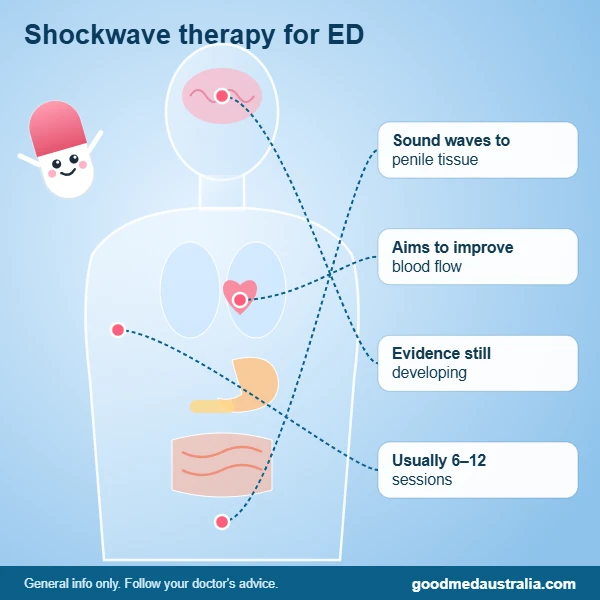
Key points at a glance
- Uses low-energy sound waves on the penis.
- Aims to improve blood flow over time.
- Results are mixed; it may help some men with mild vascular ED.
- It is not a first-line treatment in most guidelines.
- Courses can be expensive.
How it works
A handheld device delivers pulses to the penis over several sessions. The idea is that it encourages new small blood vessels to form.
What the evidence shows
Some trials show modest improvement in mild ED caused by blood flow problems, but studies vary in quality and long-term results are uncertain. Guidelines generally consider it experimental or second-line.
Before you sign up
- Ask your GP to check for heart disease and diabetes first.
- Ask the clinic for evidence and realistic success rates.
- Be wary of large upfront packages.
- Proven options like tablets work for most men.
Related guides: when ED pills do not work and how ED is diagnosed.
Frequently asked questions
Does shockwave therapy hurt?
Most men feel mild tingling only.
Is it permanent?
There is limited evidence on long-term results.
Is it covered by Medicare?
Generally no.
Who might benefit most?
Men with mild ED due to blood flow problems.
Find more trusted, plain-English health guides at goodmedaustralia.com.
In an emergency, call triple zero (000). For health advice, call Healthdirect on 1800 022 222.
Based on: European Association of Urology guidelines; Urology Society of Australia and New Zealand; NHS. General education does not replace individual medical advice. Updated November 2026.