
Sorry, nothing in cart.
Blog

Body mass index (BMI) and waist measurement are simple ways to check whether your weight may affect your health. Neither tells the whole story.
What are the adult BMI ranges?
- Under 18.5: underweight
- 18.5 to 24.9: healthy weight range
- 25 to 29.9: overweight
- 30 or above: obese
What are the limits of BMI?
BMI cannot tell fat from muscle. It is less accurate for athletes, pregnant people, people under 18, and some ethnic groups, including South Asian, Chinese, Pacific Islander, and Aboriginal and Torres Strait Islander people.
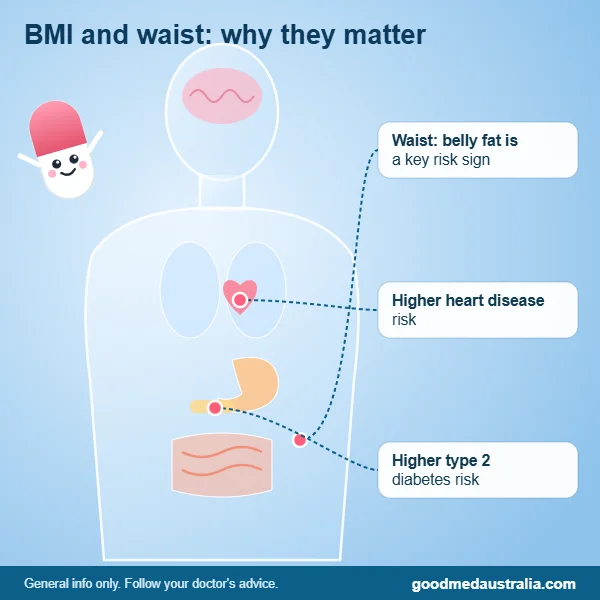
Why does waist size matter?
Fat around the waist is linked to higher health risks. Risk increases at 80 cm or more for women and 94 cm or more for men, and is greatly increased at 88 cm for women and 102 cm for men.
What should I do with my results?
Focus on healthy habits rather than a target number. Even 5% weight loss can improve health. Talk to your doctor for personal advice.
In an emergency, call triple zero (000). For health advice, call Healthdirect on 1800 022 222.
Source: Healthdirect: BMI and waist circumference. General education does not replace individual medical advice. Updated November 2026.
Find more trusted, plain-English health guides at goodmedaustralia.com.