
Sorry, nothing in cart.
Blog

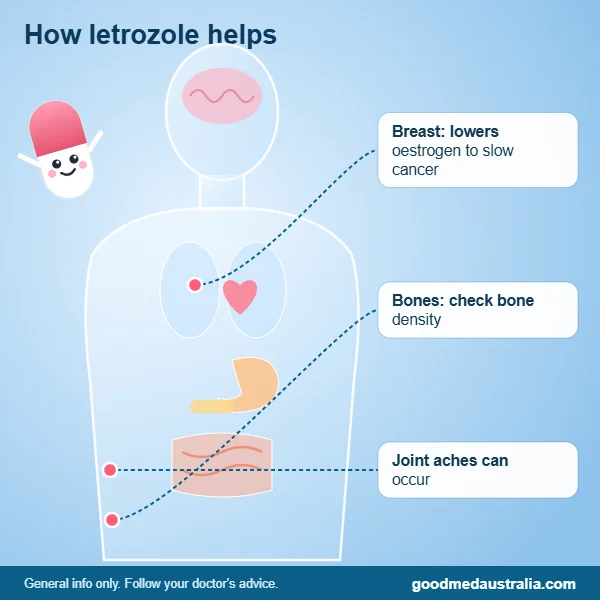
Starting letrozole often brings a mix of relief and unease. The prescription is in hand, but the information sheet lists a long run of possible effects, and it is hard to tell which ones are likely, which are minor and which need a call to the doctor. This article sorts them out, explains why they happen and shows how they differ between short and long courses.
What letrozole is, and why it has side effects
Letrozole is a prescription-only medicine (Schedule 4) regulated by the Therapeutic Goods Administration (TGA). It is a non-steroidal aromatase inhibitor, meaning it blocks the aromatase enzyme that helps convert precursor hormones into oestrogen. Less oestrogen is the point of the medicine, and it is also the source of most side effects.
Many of the common effects resemble menopause, because oestrogen levels drop in a similar way. That one idea explains most of the list that follows.
Evidence categories: approved, off-label and traditional
Letrozole is discussed in very different settings, so it helps to separate them.
- Approved use: The TGA-approved indication is hormone receptor-positive (HR+) breast cancer in postmenopausal women. Treatment in this setting generally runs for years, with duration determined by the oncology team.
- Off-label use: Letrozole is also widely prescribed off-label in Australia to induce ovulation in anovulatory subfertility, such as polycystic ovary syndrome (PCOS). This is not a TGA-approved indication. It is supported by internationally endorsed clinical guidelines, and courses are short, around five days per cycle.
- Traditional use: None. Letrozole is a synthetic pharmaceutical with no herbal or historical use. It is not a “natural hormone balancer”, and it should not be grouped with supplements.
The most common side effects
The effects most often reported come from oestrogen deprivation:
- Hot flushes and night sweats
- Joint pain (arthralgia), stiffness and muscle aching
- Marked tiredness
- Headaches and nausea
- Skin and hair changes, including thinning
- Mild mood changes
- Dizziness
Not everyone gets all of these, and severity varies a good deal from person to person. The full list in the Consumer Medicine Information (CMI) for your specific brand is the authoritative reference.
Short course versus long-term use
This is where many online articles blur things. A five-day fertility cycle and a multi-year course are very different exposures.
| Feature | Fertility (off-label) | Breast cancer (approved) |
|---|---|---|
| Typical duration | About five days per cycle | Years; individually determined |
| Side effects | Usually brief and mild | Can build up or persist over time |
| Main concerns | Short-lived symptoms during a cycle | Menopausal-type symptoms, bone and cholesterol changes |
| Monitoring | Guided by the treating doctor | Regular reviews, bone and blood tests |
Someone reading a forum post from a person taking it for years may be seeing a very different picture from what a short fertility course involves, and the reverse is also true.
Long-term effects worth knowing about
Prolonged oestrogen suppression can reduce bone mineral density, which raises the chance of osteopenia, osteoporosis and fractures. It can also raise total cholesterol and blood pressure.
For this reason, Australian prescribing guidance points to regular monitoring by your doctor. This can include bone density (DEXA) scans and blood tests for lipid levels and liver and kidney function. These checks are routine and are not a sign that something has gone wrong. They are how a doctor catches slow changes you would not otherwise notice.
Practical ways to approach side effects
Common-sense steps are often suggested for the everyday symptoms. Dressing in layers can help with flushes and night sweats, drinking water is widely recommended, and light exercise is often suggested for general wellbeing and stiffness. These are general comfort measures, not treatments, and they are no substitute for medical advice.
A few habits make appointments more useful:
- Keep a simple symptom note. Jotting down what happens, when it started and how much it affects sleep, work or movement gives your doctor something concrete to work with. Joint stiffness that is worst on waking, for example, is worth recording.
- Bring your monitoring questions. Ask when your next bone density scan or blood tests are due.
- Use your pharmacist. They can check that any over-the-counter product or supplement suits you alongside letrozole.
- Do not stop or change anything on your own. Report unexpected or bothersome symptoms to the prescriber first.
When to speak to a doctor or pharmacist
Seek emergency help for sudden chest pain, loss of vision, difficulty speaking, one-sided weakness or severe allergy. Tell your doctor promptly about a fracture, severe joint or tendon symptoms, jaundice or persistent fever. For less serious but troublesome symptoms, contact your treatment team.
Frequently asked questions
Do letrozole side effects go away?
This varies. Some people find certain effects ease over time, while others notice them throughout treatment. Because experiences differ, it is worth telling your doctor if a symptom persists.
Are the side effects the same for fertility use?
The mechanism is the same, but the research describes effects in the fertility setting as usually brief and mild because the course is only about five days per cycle. Your doctor can explain what applies to you.
Is letrozole a natural or herbal product?
No. It is a synthetic prescription medicine with no traditional use history.
Why would my doctor order bone scans or blood tests?
Long-term oestrogen suppression can affect bone density, cholesterol and blood pressure. Regular monitoring is standard practice to track these.
Conclusion
Letrozole’s side effects follow logically from what it does: lowering oestrogen. For most people that means menopause-like symptoms, with bone and cholesterol monitoring added for longer courses. The setting matters. A short fertility cycle and a multi-year approved course are different situations, and your Consumer Medicine Information and treating team are the best guide to yours. If something worries you, speak to your doctor or pharmacist before making any changes.
Pregnancy and breastfeeding
Letrozole must not be taken during an established pregnancy or while breastfeeding. Off-label ovulation induction is a separate, closely supervised use: a fertility clinician must exclude pre-existing pregnancy and specify treatment timing. Contact your prescriber immediately if pregnancy is possible during treatment.
Medicine information and further reading
- Femara Australian medicine information
- International PCOS guideline: off-label ovulation induction
Explore more health guides and our frequently asked questions. This article is general education and does not replace advice from your doctor or pharmacist.
Find more trusted, plain-English health guides at goodmedaustralia.com.