
Sorry, nothing in cart.
Blog

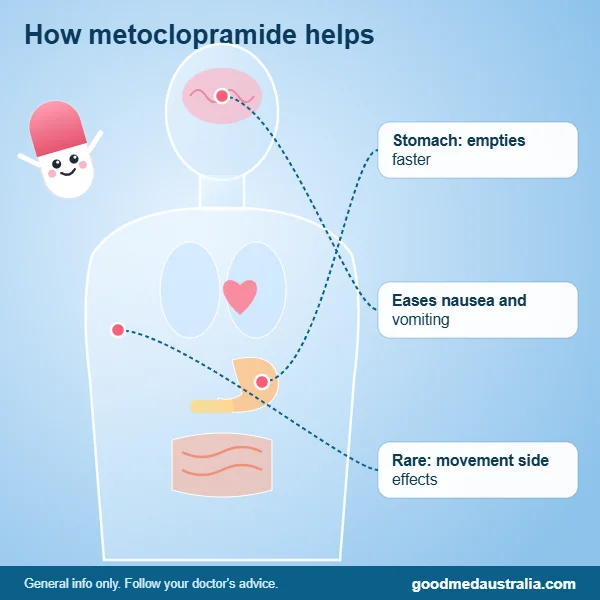
Most people who take metoclopramide expect the usual short-term complaints. The less familiar ones are the movement-related effects: a restlessness you can’t settle, a jaw that tightens suddenly, or a tongue and lips that seem to move on their own. These are uncommon, but they are the reason Australian regulators advise keeping treatment short. Knowing what they look like, and who is more likely to be affected, helps you act quickly if something seems wrong.
What metoclopramide is, and why it affects movement
Metoclopramide is a Schedule 4 (prescription-only) medicine in Australia. It blocks dopamine receptors in the brain and increases the movement of the gut. In Australia it is approved for short-term control of severe nausea and vomiting in specific situations, including after surgery, with radiation or chemotherapy, and around certain gastrointestinal procedures.
The dopamine-blocking action that settles nausea is also the reason for the movement warnings. Dopamine helps the brain coordinate smooth, controlled movement. When its signals are blocked, some people develop what doctors call extrapyramidal symptoms. The same class of effects is seen with some antipsychotic medicines.
Everyday side effects versus movement warnings
Common side effects of metoclopramide include drowsiness, fatigue and bowel changes. These are generally the more familiar and less alarming ones. The movement-related effects are different. They are less common, but they can be distressing and, in one case, long-lasting.
The four movement effects to know
- Dystonia: sudden muscle spasms, including the neck, jaw or eyes.
- Akathisia: intense restlessness and inability to sit still.
- Parkinson-like effects: tremor, stiffness or slowed movement.
- Tardive dyskinesia: repetitive involuntary movements that can persist after stopping.
Acute versus long-term: the distinction that matters
Acute dystonia and tardive dyskinesia are the two most often confused. Acute dystonia is a sudden spasm that tends to appear early and is often reversible with medical treatment. Tardive dyskinesia develops with cumulative exposure and may persist even after the medicine is stopped. That difference is the main reason long-term use is discouraged.
Who is more likely to be affected
Risk is not the same for everyone:
- Children and young adults under 20 are at higher risk of acute dystonic reactions.
- Older people and those taking the medicine for a long time are at higher risk of tardive dyskinesia.
These patterns explain the TGA’s age-related guidance, below.
What the TGA says about duration and age
The Therapeutic Goods Administration (TGA) has aligned with international guidance to limit metoclopramide to short-term use, generally a maximum of 5 days, to reduce neurological risk. For people under 20, use is restricted to second-line therapy for severe cases because of the higher risk of acute dystonic reactions.
In practice, this means a prescriber is expected to treat metoclopramide as a short-course option, not an open-ended one. If you’ve been taking it for longer than you were told to, or you’re unsure how long it should continue, ask your doctor or pharmacist rather than deciding yourself.
What you might notice: some illustrative scenarios
These are general examples, not real cases.
- A young adult who has just started the medicine feels their neck or jaw suddenly pull into a painful, involuntary position. That pattern fits the description of acute dystonia and warrants prompt medical attention.
- Someone feels unable to sit still, pacing and shifting with a strong inner restlessness that seems out of proportion to how they felt before. This is the kind of experience described as akathisia.
- An older person who has been on the medicine for a prolonged period, or a family member observing them, notices repetitive lip smacking or tongue movements. These are classic descriptions of tardive dyskinesia and should be raised with a doctor without delay.
Subtle movements are easy to miss, and the person experiencing them may not notice at all. If you care for someone taking this medicine, it helps to know what to look for.
What to do if abnormal movements appear
- Contact your doctor or pharmacist promptly. Describe what you’ve noticed and when it started.
- Stop metoclopramide if abnormal movements occur. Obtain urgent medical assessment before another dose.
- Seek emergency medical evaluation if symptoms are sudden, severe or frightening.
Frequently asked questions
Are the movement side effects permanent?
It depends on the type. Acute spasms are often reversible with medical treatment. Tardive dyskinesia can be permanent.
Does everyone who takes metoclopramide get these effects?
No. They are uncommon, and risk varies with age and how long the medicine is taken.
How long is metoclopramide meant to be used?
TGA guidance supports short-term use, generally up to 5 days. Your prescriber can explain what applies to you.
Can I stop or change my treatment if I’m worried?
For routine concerns, contact your prescriber or pharmacist. If abnormal movements occur, stop metoclopramide and seek urgent medical assessment.
Act promptly on abnormal movements
Stop metoclopramide and obtain urgent medical assessment for involuntary movements, eye rolling, jaw or neck spasms or marked restlessness. Maxolon tablets are not for children under 15; use at 15–19 is restricted to selected second-line situations. The maximum recommended treatment duration is five days.
Sources and further reading
Maxolon. Check the leaflet matching your exact product; formulations, approved uses and instructions can differ.
Explore more medicine safety guides or read our frequently asked questions.
General education only. This does not replace an individual assessment by a doctor or pharmacist. In an emergency in Australia, call 000.
Find more trusted, plain-English health guides at goodmedaustralia.com.