
Sorry, nothing in cart.
Blog

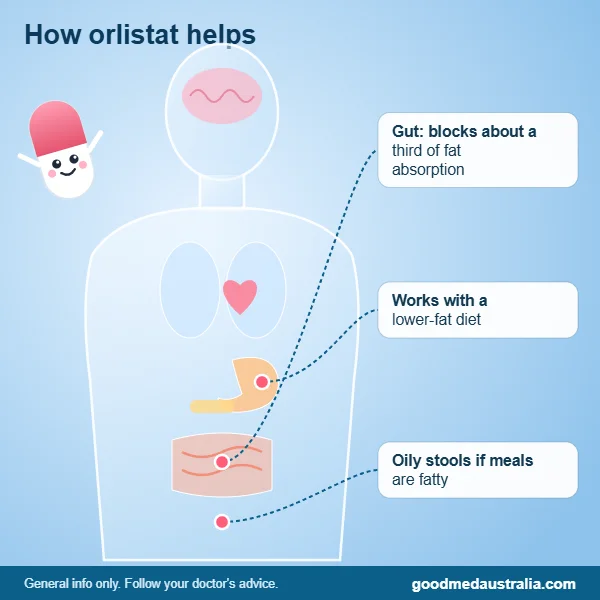
Most people who read about orlistat side effects are not asking whether the medicine is safe in the abstract. They want to know what will happen to their bowels, and whether a social lunch is going to go badly. The honest answer is that the side effects are mostly predictable, and they are closely tied to what you eat.
Why orlistat causes digestive side effects
Orlistat works locally in the gut rather than throughout the body. It inhibits pancreatic and gastric lipases, the enzymes that break down dietary fat. As a result, roughly 30% of the fat you eat is not absorbed and leaves the body in your stool.
That mechanism explains the typical symptoms:
- Fatty or oily stools (steatorrhoea)
- Oily spotting
- Gas with discharge
- Faecal urgency
- Loose stools
These digestive effects are recognised with orlistat and often increase with higher-fat meals. They should not be dismissed if severe or persistent: contact your pharmacist or doctor.
Approved use of orlistat
It helps to be clear about what orlistat is and is not.
| Category | What the evidence shows |
|---|---|
| Approved use | The Therapeutic Goods Administration (TGA) approves orlistat for weight management in adults with a BMI of 30 or above, or 27 or above when risk factors such as hypertension, dyslipidaemia or type 2 diabetes are present. It is used alongside a mildly reduced-calorie, low-fat diet. |
| Traditional use | None. Orlistat is a synthetic derivative of lipstatin, a natural lipase inhibitor from the bacterium Streptomyces toxytricini. It was developed in modern pharmaceutical science and has no herbal or traditional history. |
In Australia, orlistat products (including those sold under the brand name Xenical) can be scheduled differently, as Pharmacist Only or prescription medicines. A pharmacist can explain which applies and point you to the Consumer Medicine Information (CMI) leaflet for your product.
How diet changes the experience
Gastrointestinal side effects are proportional to how much fat you eat. Prescribing guidance pairs orlistat with a reduced-calorie diet in which fat makes up less than 30% of daily energy, and following that pattern noticeably reduces digestive symptoms.
Two practical points follow from this:
- Spread fat evenly. A modest amount of fat at each main meal is easier on the gut than one very rich meal.
- Watch the hidden fat. Pastry, creamy sauces, deep-fried food and takeaway meals can carry far more fat than they appear to.
Consider two dinners as an illustration. Grilled fish with steamed vegetables and rice is a low-fat meal. Fish and chips with a creamy sauce is not, and it is the kind of meal most likely to cause urgency and oily leakage hours later. Neither example is a prescription for what to eat. They simply show how much the same evening can differ.
Professional prescribing guidance also notes that if a meal is skipped or contains no fat, the orlistat taken with that meal is generally omitted. Confirm how this applies to you with your pharmacist or GP rather than working it out alone.
Practical ways to manage side effects day to day
- Plan around fatty meals. If you know a function or restaurant meal will be rich, think ahead about how it may affect your day.
- Keep spare supplies handy. Because oily spotting and urgency can arrive with little warning, some people find it reassuring to carry a change of underwear or pads, especially in the early weeks.
- Notice patterns. A simple food diary can show which meals trigger symptoms.
- Don’t self-adjust. If symptoms persist despite a low-fat diet, talk to your doctor or pharmacist before changing anything.
Vitamins and other medicines
Fat-soluble vitamins
Because orlistat reduces fat absorption, it also reduces absorption of the fat-soluble vitamins A, D, E and K. Healthcare providers may recommend a fat-soluble multivitamin, typically taken at least two hours before or after orlistat. Whether you need one is a question for your GP or pharmacist.
Medication interactions
Orlistat can change how some medicines are absorbed, including:
- Levothyroxine (thyroid medicine)
- Warfarin (a blood thinner)
- Antiepileptics
- Cyclosporine
Interaction management is medicine-specific. Do not assume a two-hour gap makes thyroid medicine or any other combination safe. Your pharmacist should check timing and whether blood tests or other monitoring are needed.
Oral contraceptives deserve a special mention. Severe diarrhoea, which is more likely after a high-fat meal, may impair their absorption. If you take the pill, raise this with your doctor or pharmacist before starting orlistat.
Rare but serious problems
Rare but serious risks include liver injury, oxalate-related kidney injury and severe allergy. Seek urgent assessment for severe abdominal pain, dark urine, yellowing skin or eyes, or reduced urine output. Breathing difficulty or facial/throat swelling requires emergency help.
Frequently asked questions
Do orlistat side effects go away?
They are linked to dietary fat, so they tend to ease when meals are lower in fat. If they remain troublesome, speak to a healthcare professional.
Is orlistat a traditional or herbal remedy?
No. It is a synthetic drug, although it is derived from a compound found in a soil bacterium.
Can I take my usual medicines with it?
Not always without checking. Some medicines, including levothyroxine, warfarin, antiepileptics and cyclosporine, can be affected. Ask your pharmacist.
Is orlistat approved for anything other than weight management?
The approved Australian Xenical indication is weight management alongside dietary changes for people meeting the stated BMI and risk criteria. Do not use it for another condition without a clinician’s assessment.
The bottom line
Orlistat’s side effects follow directly from how it works, and they usually reflect how much fat is on your plate. Low-fat, evenly spread meals make the biggest practical difference. Vitamin absorption and medicine interactions are the less obvious issues, and they are worth discussing before you start. This article is general information only. Speak to an Australian-registered GP or pharmacist before starting, stopping or changing any medicine or diet.
Medicine information and further reading
- Xenical Australian medicine information
Explore more health guides and our frequently asked questions. This article is general education and does not replace advice from your doctor or pharmacist.
Related medicine safety guides
These guides explain different medicines; linking them does not mean they are interchangeable or suitable for the same person.
Find more trusted, plain-English health guides at goodmedaustralia.com.