
Sorry, nothing in cart.
Blog

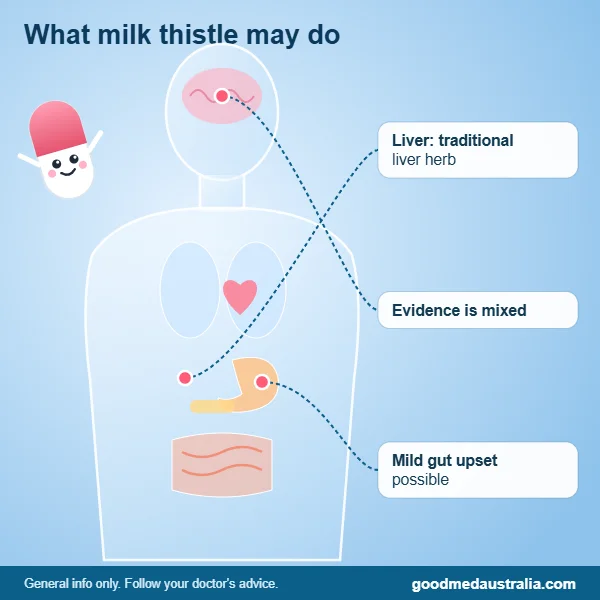
Walk through the supplement aisle of any Australian pharmacy and you will find milk thistle sitting under labels like “liver support” or “cleanse”. The packaging suggests a simple story: a hardworking organ, a helpful herb. The research is more cautious, and it is worth separating what is old tradition, what is early science and what is established fact.
What milk thistle and silymarin actually are
Milk thistle (Silybum marianum) is a spiny plant whose seeds contain silymarin, a complex of compounds called flavonolignans. The most prominent of these is silybin. When people talk about milk thistle and the liver, they are usually talking about silymarin.
Traditional use: a long history, not proof
Milk thistle has been used for more than 2,000 years in European and Mediterranean traditional medicine. It was used to support digestive comfort, assist the gallbladder and ease liver-related complaints. Folk medicine also treated it as a protective herb against environmental poisons and toxic mushrooms.
This history explains why the herb is so familiar. It does not show that the herb works. Traditional use tells us what people believed and tried, not what a controlled trial would find.
Early research: promising signals, limited conclusions
Most of the encouraging findings come from laboratory (in vitro) and animal studies. These suggest silymarin has antioxidant properties, helps scavenge free radicals and may dampen certain inflammatory signalling pathways. That is interesting biology, but results in cells and animals often do not carry over to people.
Some small human trials and meta-analyses have looked at metabolic dysfunction-associated steatotic liver disease (MASLD), previously called non-alcoholic fatty liver disease. They suggest silymarin may modestly lower elevated liver enzymes, such as ALT and AST, when combined with lifestyle changes. Two points matter here:
- The trials were small, and the effect was described as modest.
- A change in a blood marker is not the same as better long-term health outcomes.
For more serious conditions, the picture is less clear. Major systematic reviews, including Cochrane summaries, and NIH/NCCIH assessments report mixed or inconclusive results for chronic hepatitis B, hepatitis C and advanced alcohol-related cirrhosis. Nobody has shown that milk thistle reliably improves clinical outcomes in these conditions.
Evidence at a glance
| Evidence level | What it shows | How much weight to give it |
|---|---|---|
| Traditional use | Over 2,000 years of use for digestive, gallbladder and liver complaints, and as a folk antidote to poisons | Cultural context only; not evidence of effectiveness |
| Lab and animal studies | Antioxidant and anti-inflammatory activity from silymarin | Early; does not guarantee the same effect in people |
| Small human trials (MASLD) | Possible modest reduction in ALT and AST alongside lifestyle changes | Preliminary; not proof of liver repair |
| Reviews on hepatitis B, hepatitis C and cirrhosis | Mixed or inconclusive results | No established benefit for clinical outcomes |
Does milk thistle “detox” the liver?
This is the claim readers most often ask about, and the answer from Australian public health sources is clear. Healthdirect notes there is no solid scientific evidence that herbal “liver detox” or “cleanse” products improve overall liver function or replace the liver’s own detoxification processes. A healthy liver already does that work.
What does support liver health is far less glamorous: a balanced diet, regular physical activity and reducing alcohol. No supplement substitutes for these.
How Australia classifies milk thistle
In Australia, the Therapeutic Goods Administration (TGA) regulates milk thistle as a complementary medicine. Overseas bodies such as NCCIH and the Mayo Clinic take a similar stance. It is not a prescription drug, and it is not an approved cure or treatment for liver disease, cirrhosis or alcohol-related liver damage.
So when it comes to proven medical uses for liver conditions, there are none to report. Being legally available does not mean a product has been shown to treat a disease. Much of the material you find online reflects US supplement rules rather than the Australian system, which is another reason to check local sources.
Safety and interactions
Taken by mouth, milk thistle is generally well tolerated. The usual side effects are mild digestive ones: bloating, nausea and diarrhoea. There are some specific cautions, though:
- Allergy: People allergic to the Asteraceae plant family (daisies, ragweed, marigolds) may react to milk thistle.
- Blood sugar: It may lower blood glucose in people with diabetes, which could matter if they already use glucose-lowering medicines.
- Medicine interactions: It may interact with drugs processed by liver enzymes, such as CYP2C9 substrates.
- Hormone-sensitive conditions: Potential oestrogen-like activity has been raised as a caution, so people with these conditions should seek advice first.
Practical examples
- Someone with a high ALT result on a blood test: The sensible first step is a conversation with a GP about the cause, which could range from weight and diet to alcohol or medicines. Taking an herbal product first could delay finding out what is going on.
- Someone on diabetes medication: Because milk thistle may lower blood glucose, a pharmacist can help check whether it is a sensible thing to add.
- Someone with hay fever or a daisy-family allergy: The Asteraceae link means it is worth raising before trying it.
- Someone planning a “cleanse” after a big weekend: The evidence points to cutting back on alcohol and eating well, not to a herbal product.
Frequently asked questions
Can milk thistle repair a damaged liver?
There is no solid evidence that it can. Early studies show some effect on liver enzymes in MASLD, but results for hepatitis and cirrhosis are mixed or inconclusive.
Is milk thistle approved in Australia to treat liver disease?
No. It is regulated as a complementary medicine, not as an approved treatment or cure for liver disease.
Is it safe for everyone?
Not necessarily. Allergies, diabetes, hormone-sensitive conditions and certain medicines are all reasons to check first with a GP or pharmacist.
What does the evidence say supports liver health?
A balanced diet, physical activity and reducing alcohol, rather than detox or cleanse products.
The bottom line
Milk thistle has a long traditional history and some interesting early research, particularly around liver enzymes in MASLD. It has not been shown to cure, repair or “detox” the liver, and evidence in serious liver conditions remains inconclusive. If you are thinking about using it, or you are worried about your liver health, speak to your GP or pharmacist first, especially if you take prescription medicines or manage a chronic condition. This article is general education, not personal medical advice.
Find more trusted, plain-English health guides at goodmedaustralia.com.