
Sorry, nothing in cart.
Blog

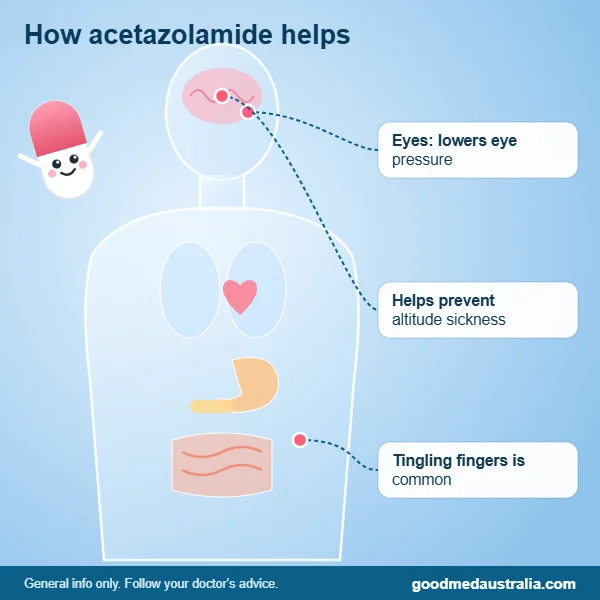
Why that pins-and-needles feeling catches people off guard
You take your first tablet before a big trek, and within a short time your fingertips, toes or lips start to tingle. It’s unsettling if nobody warned you. Tingling (paraesthesia) is among the most common effects of acetazolamide, often known by the brand name Diamox. Knowing why it happens makes it much less alarming, and it also helps you recognise when a symptom is something different.
This article explains the tingling, the other side effects, how acetazolamide is used around altitude, and where the safety boundaries sit. It is general information, not personal medical advice.
What acetazolamide is approved for in Australia
Acetazolamide is a carbonic anhydrase inhibitor. In Australia, its TGA-approved uses include:
- reducing raised pressure inside the eye in glaucoma
- helping control certain seizure disorders
- managing fluid retention (oedema) linked to heart failure or some medications
Preventing altitude sickness is not on that list. Travel health doctors in Australia do widely prescribe it for that purpose, which is called off-label use. Off-label doesn’t mean unproven or unusual. It means the use is outside the product’s official indications, so the decision rests on a doctor’s judgement of your circumstances.
Why acetazolamide causes tingling
Acetazolamide blocks the enzyme carbonic anhydrase. That causes temporary shifts in electrolytes and in the body’s acid-base balance, which in turn affects how excitable the peripheral nerves are. The result is the familiar tingling in the hands, feet and face.
Two points are worth knowing:
- It is predictable. The tingling reflects the drug’s biochemistry, not an allergic reaction in itself.
- It is dose-dependent and fades. Clinical trial data show the effect tends to be stronger at higher doses and settles after treatment stops. If it bothers you, ask your prescriber whether the plan can be adjusted. Don’t change anything yourself.
Tingling is generally regarded as harmless. Even so, tell your doctor or pharmacist if it is severe, persistent or accompanied by other symptoms, particularly if you also feel unwell in other ways.
Other common side effects
Tingling is rarely the only effect. People commonly report:
- Frequent urination. Acetazolamide has a diuretic action, so dehydration is a real risk if you don’t keep up your fluids, which matters on a hot, dry trail.
- Altered taste. Carbonated drinks, including soft drink and beer, can taste flat or metallic. This is linked to carbonic anhydrase in saliva.
- Fatigue, nausea and lightheadedness.
- Increased sun sensitivity. This is worth remembering at altitude, where sun exposure can be intense.
If travel is planned, discuss altitude illness prevention separately from side effects. Follow your own fluid plan, especially if you have heart or kidney disease; extra water is not a universal treatment for tingling.
How it fits into altitude travel
Mount Kosciuszko, at about 2,228 metres, rarely causes serious altitude illness. Most Australians asking about acetazolamide are heading overseas, to places like Nepal, Peru or Tanzania. Guidance from the RACGP and Healthdirect describes off-label use for preventing acute mountain sickness (AMS) when travelling to altitudes above roughly 2,500 to 3,000 metres.
The proposed mechanism is that acetazolamide causes a mild metabolic acidosis, which stimulates the rate and depth of breathing. That improves blood oxygen levels and speeds acclimatisation. It supports your body’s adjustment rather than bypassing it.
That leads to the most important rule in this article: acetazolamide is not a substitute for gradual ascent. If severe altitude illness develops, such as high-altitude pulmonary oedema (HAPE) or high-altitude cerebral oedema (HACE), the response is descent and urgent medical care, not more medication. Someone who feels fine on a tablet but climbs too fast has not removed the risk.
Who needs to be careful
Acetazolamide is unsuitable with certain kidney or liver problems or low sodium or potassium. Your prescriber must assess contraindications. Mention a history of serious sulfonamide reactions.
- significant kidney impairment
- severe liver disease
- low sodium or potassium levels
- severe pulmonary obstruction
Pregnancy is another common question, and it is one to raise with your doctor early rather than at the last minute before a flight.
Rare but serious risks include severe skin reactions such as Stevens-Johnson syndrome and significant electrolyte imbalances. A new rash, blistering, mouth sores or feeling very unwell calls for immediate medical attention.
Frequently asked questions
Is tingling from acetazolamide dangerous?
It is generally considered harmless and usually settles once the medicine is stopped. If it is severe, persistent or comes with other symptoms, check with your doctor or pharmacist.
Can I buy it without a prescription for a trip?
Acetazolamide is a prescription medicine, so a consultation is the starting point. A travel health doctor can weigh up your itinerary, health history and other medicines.
Why does my fizzy drink taste odd?
Carbonic anhydrase is present in saliva, and blocking it can make carbonated drinks taste flat or metallic. It’s a recognised effect of the medicine.
Does it replace acclimatising slowly?
No. A gradual ascent remains the foundation of altitude safety, and descent is essential if severe illness such as HAPE or HACE develops.
Important interactions
Aspirin can interact with acetazolamide; high-dose aspirin has been associated with severe toxicity. Check before combining them. Tingling accompanied by weakness, confusion, severe rash or breathing problems must not be assumed harmless; obtain urgent care.
Sources and further reading
Diamox. Check the leaflet matching your exact product; formulations, approved uses and instructions can differ.
Explore more medicine safety guides or read our frequently asked questions.
General education only. This does not replace an individual assessment by a doctor or pharmacist. In an emergency in Australia, call 000.
Find more trusted, plain-English health guides at goodmedaustralia.com.