
Sorry, nothing in cart.
Blog

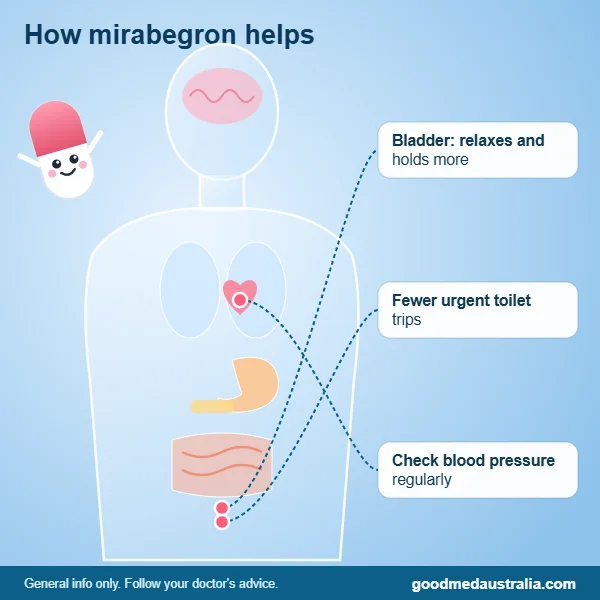
If you have been prescribed mirabegron, or are wondering whether it might suit you, two questions tend to come up quickly. Will it affect my blood pressure? And what does it do to the bladder it is meant to help? Both are fair questions, and the answers are more specific than most online summaries suggest.
What mirabegron is, and what it is approved for
Mirabegron relaxes the bladder muscle through beta-3 adrenergic receptors. It works differently from antimuscarinic bladder medicines, although side effects and interactions still need review.
Its proven, approved use is clear. The Therapeutic Goods Administration (TGA) has approved it for the symptomatic treatment of urgency, increased urinary frequency and urgency incontinence associated with overactive bladder (OAB) syndrome in adults.
How it works, and why that matters for side effects
Mirabegron is a selective beta-3 adrenergic receptor agonist. It stimulates beta-3 receptors in the detrusor, the bladder’s muscle wall, which helps the muscle relax while the bladder fills. That increases bladder capacity.
It does not block muscarinic receptors. Those are the targets of older OAB medicines (anticholinergics or antimuscarinics), and blocking them is what typically causes dry mouth and constipation. This mechanism explains why mirabegron is associated with a lower incidence of dry mouth and cognitive effects than those older medicines. It does not mean mirabegron is free of side effects, just that they tend to differ.
Mirabegron and blood pressure
This is the side effect that deserves the most attention. Mirabegron can raise both blood pressure and pulse rate, and hypertension is among the most frequently reported side effects in clinical trials.
The specific safety limit
Mirabegron is contraindicated in people with severe uncontrolled hypertension, defined as systolic pressure of 180 mmHg or higher and/or diastolic pressure of 110 mmHg or higher. Many general articles leave out these figures.
What about people with existing high blood pressure?
The contraindication applies to severe, uncontrolled hypertension. It does not automatically rule out everyone with a hypertension diagnosis. That judgement belongs to your prescriber, who will weigh your readings, your other medicines and your overall health.
Monitoring
Prescribing information calls for a baseline blood pressure measurement before treatment and periodic checks during it. The research I have drawn on does not set out a fixed schedule, so how often you are checked is a decision for your doctor. If you have a home blood pressure monitor, ask whether keeping a record of your readings would be useful to bring to appointments.
Bladder health: infections and difficulty emptying
Urinary tract infections (UTIs) are among the common adverse reactions reported with mirabegron. This can seem odd for a bladder medicine, but it is a documented finding. Headache and nasopharyngitis (inflammation of the nose and throat, similar to a common cold) are also frequently reported.
Urinary retention, meaning difficulty emptying the bladder, is a separate concern. Caution is advised in two situations:
- Bladder outlet obstruction (BOO): where something restricts urine flow out of the bladder.
- Taking an antimuscarinic at the same time: the combination raises the risk of retention.
Combination treatment needs a prescriber’s review because urinary retention has been reported, including in people with bladder outlet obstruction or taking antimuscarinics. Tell your pharmacist about every bladder medicine you use.
Practical steps before and during treatment
- Tell your prescriber about your blood pressure history, including any readings you know of that have been high.
- Mention any trouble passing urine or a weak or slow stream, since bladder outlet obstruction affects the risk of retention.
- Bring a complete medicines list, especially any other bladder medicine.
- Read the Consumer Medicine Information (CMI) for Betmiga, which is the official local source for side effects and precautions.
- Do not stop or change your medicine on your own. Speak to your doctor or pharmacist first.
When to seek advice
Contact your GP or pharmacist if you notice changes after starting mirabegron, such as readings that are higher than usual, new difficulty emptying your bladder, or symptoms that suggest a urinary infection. If you feel acutely unwell, or a symptom is severe or sudden, seek urgent medical care or call 000.
You can also report a suspected side effect through the TGA’s adverse event reporting system. Your pharmacist or doctor can help you with this. These reports help regulators monitor medicine safety across Australia.
Frequently asked questions
Does mirabegron raise blood pressure?
It can. It may increase blood pressure and pulse rate, which is why a baseline measurement and periodic monitoring are required.
Can I take it if I have high blood pressure?
It is contraindicated in severe uncontrolled hypertension (systolic 180 mmHg or above and/or diastolic 110 mmHg or above). Beyond that, your doctor decides whether it is suitable for you.
Does it cause dry mouth like older bladder medicines?
It is associated with a lower incidence of dry mouth and cognitive effects, because it does not block muscarinic receptors.
Can it cause urinary retention?
Caution is advised in people with bladder outlet obstruction and in those also taking antimuscarinic medicines, because the risk of retention is higher.
Urgent symptoms
Inability to pass urine needs urgent assessment. Severe headache with chest pain, weakness, confusion or visual disturbance needs emergency care. Stop the medicine and seek emergency help for tongue or throat swelling or breathing difficulty.
Sources and further reading
Betmiga. Check the leaflet matching your exact product; formulations, approved uses and instructions can differ.
Explore more medicine safety guides or read our frequently asked questions.
General education only. This does not replace an individual assessment by a doctor or pharmacist. In an emergency in Australia, call 000.
Find more trusted, plain-English health guides at goodmedaustralia.com.