
Sorry, nothing in cart.
Blog

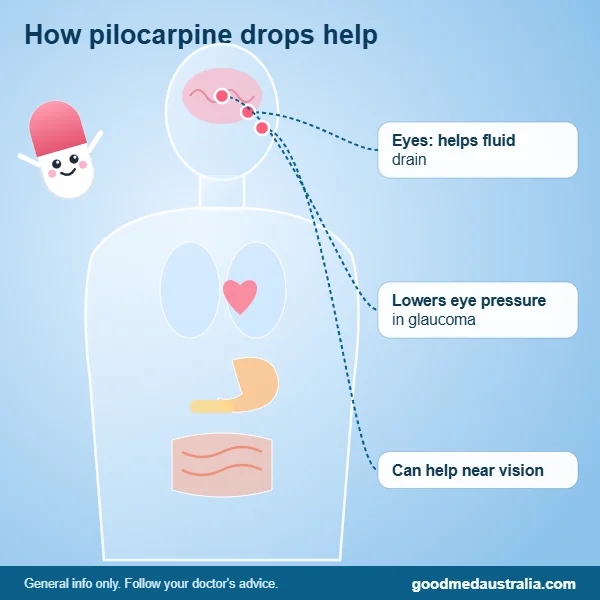
Pilocarpine eye drops have a long history in glaucoma treatment. They can also cause brow ache, blurred vision and difficulty seeing in dim light. This guide explains what to discuss with an eye specialist.
What pilocarpine is
Pilocarpine was originally derived from the leaves of Pilocarpus plants, which are native to South America. It is known as a cholinergic medicine, meaning it stimulates certain nerve-driven responses in the body, including saliva production and constriction of the pupil. It was one of the earliest therapies adopted in modern ophthalmology, more than a century ago, for glaucoma management, before newer classes of eye drops arrived.
What it is approved for in Australia
In Australia, pilocarpine eye drops are indicated to lower intraocular pressure (the pressure inside the eye). The conditions named are open-angle glaucoma, acute angle-closure glaucoma and ocular hypertension. They are Schedule 4 medicines, so a prescription is required.
How it works in the eye
Pilocarpine does two things that matter here. It constricts the pupil, a change called miosis. It also makes the ciliary muscle, the small muscle inside the eye that adjusts focus, contract. Together these changes alter how fluid drains from the eye and change the eye’s depth of focus.
The “pinhole effect” in presbyopia research relies on the smaller pupil. A smaller opening can make near objects appear sharper for a time, much like squinting through a tiny hole. Understanding the mechanism also explains most of the side effects.
Common side effects and why they happen
- Burning or stinging when the drops go in.
- Blurred vision and headache.
- Brow ache, a dull ache around the eyebrow, caused by the ciliary muscle contracting.
- Reduced vision in dim light, because a constricted pupil lets in less light.
- Eye redness.
A smaller pupil can reduce vision in dim light. Do not drive if your sight is affected. New, persistent or worsening visual changes need assessment rather than assuming they are a harmless effect.
Night driving and dim environments
Because the pupil is smaller, it is harder for the eye to adapt to the dark. Night driving can be hazardous while the drops are active. Take extra care in poorly lit places, such as an unlit driveway, a dim stairwell or a car park after dark. If you are unsure whether you should drive after using them, ask your doctor or pharmacist.
Retinal detachment warning signs
Rarely, miotic drops like pilocarpine can increase tension on the retina. Sudden flashes of light, new floaters or a curtain-like shadow over your vision need immediate medical attention. Do not wait to see whether it passes.
Whole-body effects
Occasionally the medicine is absorbed more than intended and causes systemic cholinergic effects. These include sweating, muscle tremors, nausea or breathing difficulties. Any of these after using eye drops should be reported to a health professional promptly.
Contact lenses
Soft contact lenses should generally be removed before the drops are applied. Your pharmacist or the Consumer Medicine Information (CMI) leaflet can explain the details for your product.
Where to find reliable information
The Australian Commission on Safety and Quality in Health Care hosts the Isopto Carpine CMI. Healthdirect Australia provides a pilocarpine overview. Mayo Clinic and MedlinePlus also publish drug information on pilocarpine eye drops. A pharmacist can walk you through the leaflet for the specific product you have been prescribed.
Frequently asked questions
Can I buy pilocarpine eye drops over the counter in Australia?
No. They are Schedule 4 prescription-only medicines. Articles that mention over-the-counter availability are usually describing other countries.
Are the reading-vision drops I read about overseas available here?
Do not use glaucoma drops as a substitute for reading glasses or an eye examination. Australian approval and instructions depend on the exact product; ask your eye specialist.
Why does my brow hurt after using the drops?
Brow ache is a recognised effect of the ciliary muscle contracting. If it is persistent or severe, speak to your doctor or pharmacist.
When should I seek urgent help?
Seek immediate medical attention for sudden flashes of light, new floaters or a curtain over your vision. Breathing difficulties or other whole-body symptoms also need prompt care.
When care cannot wait
Flashes, new floaters, a curtain over vision or sudden loss of sight require urgent eye assessment. Severe breathing difficulty, collapse or a serious allergic reaction is an emergency; call 000.
Sources and further reading
Isopto Carpine. Check the leaflet matching your exact product; formulations, approved uses and instructions can differ.
Explore more medicine safety guides or read our frequently asked questions.
General education only. This does not replace an individual assessment by a doctor or pharmacist. In an emergency in Australia, call 000.
Find more trusted, plain-English health guides at goodmedaustralia.com.