
Sorry, nothing in cart.
Blog

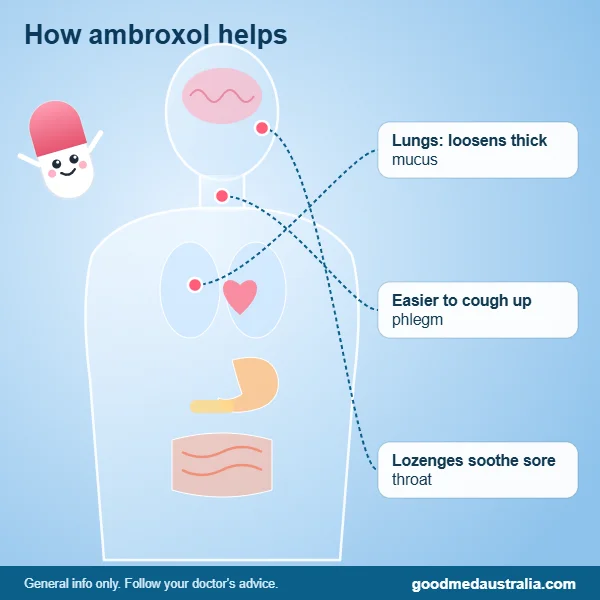
Ambroxol is an ingredient used in some mucus-clearing medicines overseas. Overseas availability does not establish Australian approval. A pharmacist can check the current register and appropriate locally available options for your symptoms.
What ambroxol is and how it works
Ambroxol is a mucolytic and secretolytic agent. In plain terms, it helps thin and loosen thick airway mucus so the body can clear it more easily. It is not a cough suppressant, which is a common point of confusion. It aims to make a chesty, productive cough easier to manage, not to switch the cough off.
The research describes several actions in the airways: thinning bronchial mucus, stimulating the production of pulmonary surfactant, and supporting mucociliary clearance, the process by which tiny hair-like cilia move mucus out of the airways. Ambroxol also has a local anaesthetic effect through sodium channel blockade, which explains why some throat lozenges sold internationally contain it for sore throat relief.
Ambroxol and bromhexine: the Australian picture
Ambroxol is the active metabolite of bromhexine, meaning bromhexine is converted into ambroxol in the body. The two are closely related but are not the same product, and the difference matters here.
Bromhexine is registered and available over the counter in Australia, for example in chesty cough products such as Bisolvon. Ambroxol itself is not registered on the Australian Register of Therapeutic Goods (ARTG) by the Therapeutic Goods Administration (TGA) for commercial supply. So a product label or website that mentions ambroxol is not describing something you would normally find on an Australian pharmacy shelf.
A practical example: you have seen a cough product online or on an overseas trip and want to know if it is the same as what is sold at home. The ingredient list is the first thing to check, and a pharmacist can compare it with locally registered options. Registration means the TGA has assessed a product for quality, safety and efficacy. An unregistered product has not been through that process for Australian supply.
Safety: what is common and what is rare
Ambroxol is generally well tolerated. The most commonly reported side effects are mild gastrointestinal symptoms such as nausea or indigestion.
Many general health pages stop there, but regulators have flagged something more serious. International pharmacovigilance reviews by the European Medicines Agency’s safety committee (PRAC), along with the TGA, highlight a rare risk of severe allergic reactions, including anaphylaxis, and of Severe Cutaneous Adverse Reactions (SCARs) such as Stevens-Johnson syndrome. These are uncommon, but they are the reason a rash, blistering, skin peeling or swelling after taking any medicine should be taken seriously and assessed by a doctor promptly.
The same safety logic applies to bromhexine, the registered Australian ingredient. The European assessment covered ambroxol and bromhexine products together.
When to talk to a doctor or pharmacist
- A cough that will not settle. A persistent cough deserves proper assessment, not guesswork with an imported product.
- Considering an unregistered medicine. Speak to a doctor or pharmacist first about the risks and about registered alternatives.
- Interest in MND or Parkinson’s research. Trial eligibility is decided by the treating specialist and the research team. MND Australia is a starting point for information on current studies.
- Possible allergic or skin reactions. Seek urgent medical help.
Frequently asked questions
Is ambroxol the same as bromhexine?
No, but they are closely linked. Ambroxol is the active metabolite of bromhexine. Bromhexine is available in Australia in registered products, while ambroxol is not registered on the ARTG for commercial supply.
Is ambroxol a cough suppressant?
No. It is a mucolytic and secretolytic agent, which means it works on the thickness and clearance of mucus rather than suppressing the cough reflex.
Is ambroxol a proven treatment for MND or Parkinson’s disease?
No. Research into high-dose ambroxol for these conditions is at an early stage and it is not an approved treatment.
What are the main side effects?
Mild stomach upset, nausea and indigestion are the most commonly reported. Rare but serious allergic and severe skin reactions have been flagged by regulators.
Severe skin or allergic reactions
Stop ambroxol and seek medical help immediately for a new rash or skin swelling. Blisters, peeling skin, mouth sores or breathing difficulty require urgent assessment; call 000 for severe breathing difficulty or collapse. Do not use high-dose trial regimens for self-treatment.
Sources and further reading
EMA ambroxol safety review. Check the leaflet matching your exact product; formulations, approved uses and instructions can differ.
Explore more medicine safety guides or read our frequently asked questions.
General education only. This does not replace an individual assessment by a doctor or pharmacist. In an emergency in Australia, call 000.
Find more trusted, plain-English health guides at goodmedaustralia.com.