
Sorry, nothing in cart.
Blog

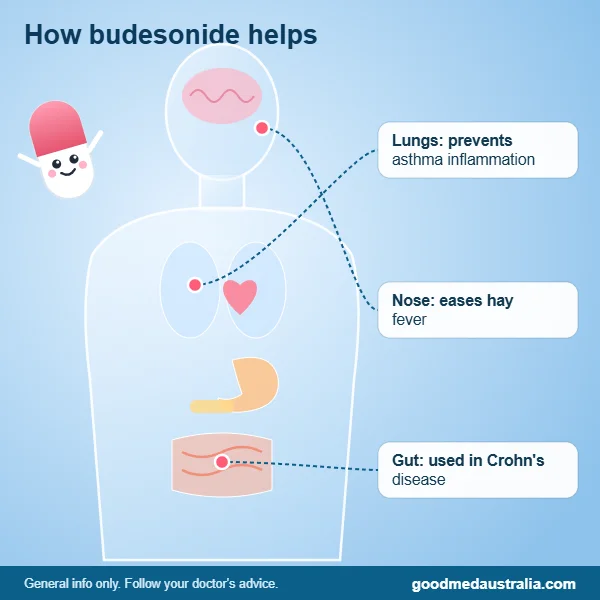
If you’ve been prescribed budesonide, you’ve probably read the leaflet and wondered which warnings apply to you. A hay fever spray, an asthma inhaler and a gut-targeted capsule all contain the same medicine, yet they don’t carry the same risks. Many online lists blur the three together, which makes the whole drug sound more alarming, or more harmless, than it is.
This article separates the forms so you can see what to expect from each. It is general education only, not personal medical advice.
What budesonide is, and what it isn’t
Budesonide is a modern synthetic corticosteroid. It isn’t a herbal product and has no traditional or folk-medicine history, so there is no “traditional use” to weigh up. Its design goal is local action: in the airways, the nasal passages or the gut lining.
The liver clears much of the drug quickly (high first-pass metabolism), so less reaches the rest of the body than with older oral steroids such as prednisolone. That is why budesonide generally causes fewer whole-body effects. “Fewer” doesn’t mean “none”, and the risk rises as more of the drug is absorbed.
Approved uses versus early research
Approved uses
Depending on the form, recognised indications include maintenance treatment of asthma, allergic rhinitis (hay fever), Crohn’s disease, ulcerative colitis and eosinophilic oesophagitis. Australian brands you may see include Pulmicort and Symbicort (inhaled), Rhinocort (nasal), and Entocort, Jorveza and Cortiment (oral). Which product suits a person is a decision for their prescriber.
Inhaled budesonide: mostly mouth and throat
Inhaled budesonide (puffers and nebulised respules) mainly causes local effects:
- Hoarseness
- A dry throat
- Coughing
- Fungal infection of the mouth or throat (oropharyngeal candidiasis, or thrush)
Thrush is the one most people ask about, because it is the most preventable. Some of the medicine lands in the mouth and throat instead of the lungs, and the steroid can let yeast overgrow there. Rinsing your mouth with water and spitting it out after each use reduces the risk. If you use a puffer with a spacer, it can reduce how much medicine settles in the mouth, though your pharmacist can show you the right technique for your device.
A practical example: someone who uses their preventer puffer in the morning and then goes straight to a coffee has left the medicine sitting in their mouth. Building the water rinse into the routine, such as at the bathroom sink before breakfast, makes it harder to forget.
Nasal budesonide: irritation and nosebleeds
Nasal sprays tend to cause problems where the spray lands:
- Burning or stinging
- Sneezing
- Dry nasal passages
- Bloody mucus
- Nosebleeds (epistaxis)
Spraying away from the nasal septum, the wall between your nostrils, is a common way to lower the chance of nosebleeds. A pharmacist can demonstrate the angle, which is usually easier to learn by watching than by reading. If bleeding keeps happening or is heavy, tell your doctor rather than just putting up with it.
Oral budesonide: the form with more whole-body exposure
Oral targeted-release capsules and tablets expose the body to higher drug concentrations than inhalers or sprays do. Reported effects include:
- Headache
- Nausea
- Indigestion
- Fluid retention
- A mild rise in blood pressure
- Mood changes
With long-term use, the concerns widen to suppression of the adrenal glands and reduced bone density. The adrenal glands make the body’s own steroid hormones, and they can become less active when a steroid medicine is taken for a long time.
For this reason, don’t stop an oral form suddenly without medical supervision. If side effects trouble you, ring your doctor or pharmacist first. They can tell you whether to adjust, switch or taper the medicine.
Children, bones, eyes and immunity
Long-term corticosteroid use raises a few broader questions, and it’s worth knowing them before you go to an appointment.
- Growth in children. Prolonged use of corticosteroids, including inhaled or nasal budesonide, can affect growth velocity. Doctors usually check a child’s height periodically for this reason. Never withhold a prescribed medicine from a child on your own. Raise the concern with the prescriber.
- Bones, eyes and immunity. Bone density loss, raised eye pressure (glaucoma), cataracts and immune suppression are all discussed in connection with longer-term steroid use. The risk varies with the form and how much reaches the bloodstream, so ask your doctor what monitoring suits your situation.
When to get help quickly
Seek urgent medical advice for:
- Signs of a severe allergic reaction
- Signs of an active infection
- Possible adrenal insufficiency, such as severe weakness, vomiting, dizziness or fainting
In an emergency in Australia, call 000. For less urgent concerns, Healthdirect (1800 022 222) or your pharmacist can help you decide what to do next.
Frequently asked questions
Is budesonide the same as prednisolone?
No. Both are corticosteroids, but budesonide is designed to act locally and is heavily cleared by the liver, so it generally causes fewer whole-body effects.
Can I prevent thrush from an inhaler?
You can lower the risk. Rinse your mouth with water and spit it out after every inhalation. A spacer may also help, depending on your device.
Why does my nasal spray make my nose bleed?
Nasal sprays can dry and irritate the lining of the nose. Aiming the spray away from the septum may help, and persistent bleeding should be checked by a doctor.
Is it safe to stop oral budesonide if I feel fine?
Not without medical advice. Stopping suddenly after long-term use can be a concern because of adrenal suppression, so talk to your doctor first.
Does budesonide cause weight gain or mood swings?
Oral forms have been linked to fluid retention and mood changes. Inhaled and nasal forms are far less likely to cause whole-body effects. Mention any changes to your doctor or pharmacist.
The takeaway
Budesonide’s side effects depend heavily on the route. Inhaled forms mostly affect the mouth and throat, nasal sprays mostly affect the nose, and oral forms carry the greatest potential for effects elsewhere in the body, especially over time. A few habits go a long way: rinse after inhalers, aim nasal sprays carefully, and don’t stop oral forms abruptly.
This article is educational and does not replace personal medical advice. If you are worried about a side effect, or want to change how you take any corticosteroid, speak to your doctor or pharmacist first.
Sources
- Pulmicort Australian medicine information
- Rhinocort Australian medicine information
- Entocort Australian medicine information
For more general medicine information, visit our Health Guides and frequently asked questions.
Find more trusted, plain-English health guides at goodmedaustralia.com.