
Sorry, nothing in cart.
Blog

Most households have a tube of something in the bathroom cabinet for an itchy bite or a patch of irritated skin. Hydrocortisone cream is one of the most familiar. It is also one of the easiest to misuse, because it feels like a harmless all-purpose cream when it is actually a mild steroid medicine. Knowing what it is for, and what it is not for, makes a real difference to using it sensibly.
What hydrocortisone cream is
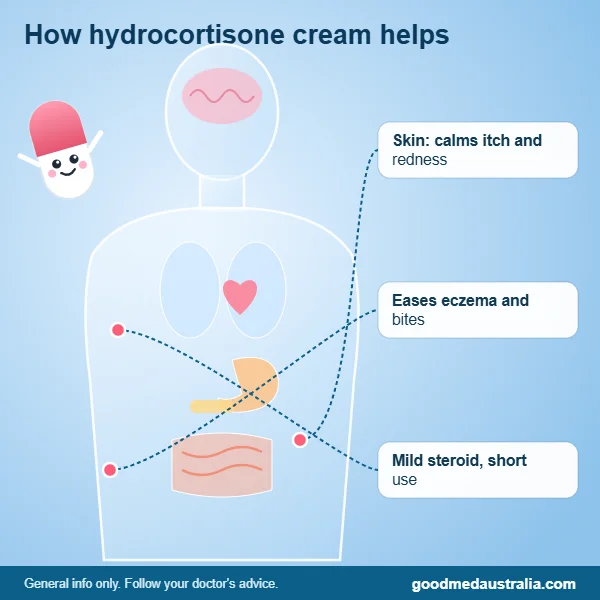
Hydrocortisone is classified as a mild topical corticosteroid. It calms the skin’s inflammatory response, which is why it can ease redness, swelling and itching. The key word is ease. It relieves symptoms for a short time. It does not cure an underlying skin condition, and it does not replace working out why the skin is irritated in the first place.
Approved uses in Australia
In Australia, hydrocortisone creams are regulated by the Therapeutic Goods Administration (TGA). The approved use is the temporary relief of redness, swelling, itching and discomfort from non-infected inflammatory skin problems. These include:
- mild eczema
- contact dermatitis, such as reactions to soaps, detergents, cosmetics or jewellery
- insect bites
- sunburn
- minor anal or genital itching
A practical example: someone develops an itchy red patch on their wrist after wearing a new bracelet. That is a typical contact reaction, and a mild steroid is the sort of product a pharmacist might discuss. Removing the trigger matters as much as the cream.
Strengths and how they are scheduled
Australia sorts medicines into schedules, and this explains why the shelf looks the way it does in a pharmacy.
| Strength | Schedule | What it means |
|---|---|---|
| 0.5% hydrocortisone | Schedule 2 (Pharmacy Medicine) | Available in pharmacies for minor skin irritations |
| 1% hydrocortisone | Schedule 3 (Pharmacist Only Medicine) | Requires a conversation with the pharmacist first |
| Above 1% and more potent corticosteroids | Schedule 4 (Prescription Only Medicine) | Prescribed by a doctor |
The pharmacist conversation for 1% products is not a formality. It is a chance to check that the problem is suited to a mild steroid, that the area of skin is appropriate, and that infection is not part of the picture. If a mild product is not enough, the next step is a doctor’s assessment rather than reaching for something stronger without advice.
Short-term use is the principle
Hydrocortisone cream is intended for short-term, external use only. Product guidance typically limits use to around seven consecutive days unless a doctor is supervising. Specific directions vary by product, so follow the label and your pharmacist’s advice. If the skin has not improved in that time, or the problem keeps returning, that is a signal to get it checked, not to keep applying the cream.
Prolonged or incorrect use is linked to skin thinning (atrophy), rebound flare-ups, steroid acne, perioral dermatitis and, in some circumstances, absorption into the body. This is the main reason steroid creams are treated with more care than ordinary moisturisers.
Face, skin folds and children
Not all skin absorbs a cream equally. The face, eyelids, neck folds and genital areas have thinner skin, and absorption there is significantly higher. A mild steroid acts more strongly in these places than it would on, say, a forearm. This is why general advice is to avoid the eye area and to speak to a pharmacist or doctor before using hydrocortisone on the face or other delicate sites.
The same applies to infants and young children. Their skin and circumstances call for individual advice, so check with a GP or pharmacist before using any steroid cream on a child.
When hydrocortisone should not be used
Hydrocortisone dampens the skin’s local immune response. That is helpful for inflammation, but a problem when the cause is an infection. It should not be applied to active:
- fungal infections, such as tinea, ringworm or thrush
- bacterial infections
- viral infections, such as cold sores or chickenpox
In these cases the cream can allow the infection to spread or mask its symptoms, making it harder to recognise and manage. A red, itchy groin rash is a good example. It might be irritation, but it might be a fungal infection, and the two need quite different approaches. If you are unsure what is causing a rash, a pharmacist or doctor can help before anything is applied.
Common misguided uses
Some home habits are not supported by the approved uses. Hydrocortisone is not a moisturiser and does not treat acne. Using it as an everyday face cream can lead to perioral dermatitis, steroid acne and localised skin thinning. Likewise, it is not appropriate for cold sores. These are not traditional remedies with a long history. They are simply misunderstandings of what a mild steroid is for.
What early research suggests
Two areas of emerging research are worth knowing about, though neither changes the approved uses above.
- Formulation: Research suggests that creams in which hydrocortisone is dissolved may penetrate skin better, and act more locally, than formulations where it is suspended. This is one reason products with the same stated strength may not behave identically.
- Barrier care: Clinical literature increasingly emphasises pairing short-term anti-inflammatory treatment with regular emollient or ceramide-based barrier repair, rather than relying on hydrocortisone alone for ongoing skin maintenance.
These ideas are still developing, so treat them as context rather than instructions. A pharmacist or doctor can advise on how they apply to your skin.
Frequently asked questions
Is hydrocortisone cream the same as a moisturiser?
No. It is a mild steroid medicine for short-term symptom relief. It does not hydrate or repair the skin barrier in the way an emollient does.
Why do I need to talk to a pharmacist for the 1% strength?
In Australia, 1% hydrocortisone is a Schedule 3 Pharmacist Only Medicine. The 0.5% strength is Schedule 2 and sits on pharmacy shelves. The pharmacist can check the product suits your situation.
Can I use it on my face?
Facial skin is thinner and absorbs more, and misuse can cause perioral dermatitis and steroid acne. Speak to a pharmacist or doctor first.
What if the rash does not settle?
See a doctor or pharmacist. A rash that persists or keeps returning may need a different assessment, and stronger steroids are prescription-only for good reason.
In summary
Hydrocortisone cream has a clear, limited role: short-term relief of itching, redness and swelling in non-infected skin irritation. It is mild, but not trivial. Strength, body site, duration and the true cause of the rash all matter. If you are unsure about any of those, speak to your GP or pharmacist before starting. This article is general information only and is not a substitute for personal medical advice.
Related guides
- Clotrimazole Cream: Uses, Safety and How It Works
- Terbinafine Cream: Uses, How Fast It Works
- Miconazole Cream Australia: Uses, Safety & Advice
Also read: Hydrocortisone Cream: Uses, Side Effects and Precautions.
Find more trusted, plain-English health guides at goodmedaustralia.com.