
Sorry, nothing in cart.
Blog

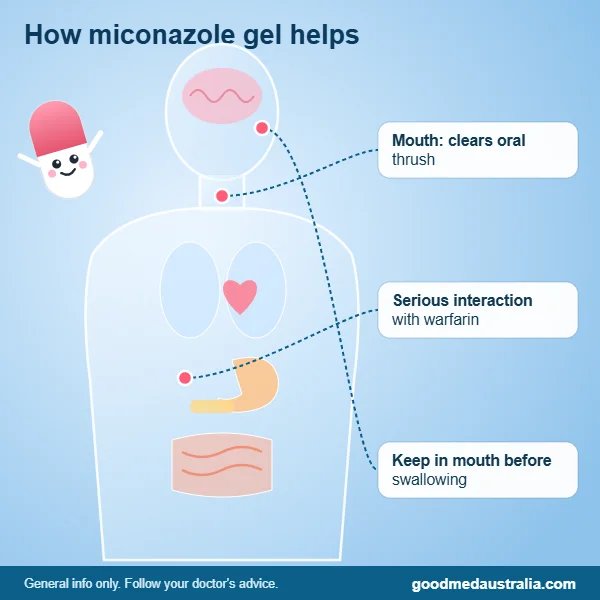
A white coating on the tongue, a sore mouth and a tube of gel at the pharmacy can make oral thrush seem like a simple problem with a simple fix. With miconazole oral gel, though, the fine print matters. Although it is applied inside the mouth, it can be absorbed into the body and interact with other medicines. That surprises many people.
This article explains what miconazole oral gel is approved for, which interactions deserve the most caution, and why it is not suitable for everyone. It is general education, not personal medical advice.
What miconazole oral gel is approved for
Miconazole is a synthetic imidazole antifungal. Oral gel is approved for clinically diagnosed oral candidiasis, commonly called oral thrush, in adults and in infants aged 6 months and older. It is also used for Candida-associated denture stomatitis, which is soreness and redness under dentures. In Australia it is sold under brands such as Daktarin, and generic versions such as Decozol are also listed.
Supply is controlled. According to the research behind this article, certain pack sizes are Pharmacist Only (Schedule 3) and others are Prescription Only. In practice, a pharmacist or doctor is meant to ask about your health and your other medicines before you get it. That conversation is a safety check, not a formality.
Why a “mouth-only” gel still matters for the rest of your body
A common assumption is that anything applied in the mouth stays in the mouth. Miconazole oral gel doesn’t work that way. It is absorbed into the bloodstream and strongly inhibits liver enzymes (CYP2C9 and CYP3A4) that help the body break down many other medicines. When those enzymes are blocked, other drugs can build up to higher levels than intended.
Interaction warnings worth knowing
Warfarin and other blood thinners
This is the best-documented concern. The UK medicines regulator (MHRA) issued a safety alert that over-the-counter miconazole oral gel is contraindicated in people taking warfarin. Combining the two can raise the INR, the blood test used to monitor how long blood takes to clot, and may lead to severe or potentially fatal bleeding. People taking warfarin should not use over-the-counter miconazole oral gel and should speak to their doctor or pharmacist instead.
Statins, sedatives and heart medicines
Because miconazole affects CYP3A4, the Daktarin consumer medicine information lists medicines that should not be combined with it. These include certain statins (simvastatin and lovastatin), sedatives (midazolam and triazolam) and some cardiac medicines. It is also contraindicated in people with severe liver dysfunction or a known hypersensitivity to imidazole antifungals.
A practical example
Imagine someone who takes a cholesterol tablet every night and has woken up with a sore, coated mouth. They might assume a mouth gel can’t affect a tablet they swallow. Based on the interaction information above, that assumption could be wrong. The simplest safeguard is to bring your medicine list, including over-the-counter products and supplements, to the pharmacy counter. Some people carry a list on their phone for this reason.
Infants and children: the choking risk
Miconazole oral gel is contraindicated in infants under 6 months, and in infants whose swallowing reflex is not fully developed. The concern is airway obstruction, because a thick gel can cause choking. For older infants who have been prescribed it, clinical guidelines such as those from SA Health stress applying small amounts to the front of the mouth, not the back of the throat. Parents should not improvise. If a baby has white patches in the mouth or is feeding poorly, it is best to have them assessed by a doctor first.
Dentures and thrush
Dentures can be a hidden source of ongoing irritation. WA Health guidance describes denture-related thrush as needing attention to the denture itself, including removing and cleaning it before any gel is applied to its surfaces. Treating the mouth while leaving a contaminated denture in place is a common reason for a problem to return. A pharmacist or dentist can explain the correct routine for your situation.
Proven, early and traditional: keeping the evidence straight
| Category | What it covers | Status |
|---|---|---|
| Approved use | Clinically diagnosed oral thrush in adults and infants 6 months and older; Candida-associated denture stomatitis | Regulator-approved |
| Early research | Studies of how much miconazole is absorbed through inflamed versus healthy mouth lining; laboratory work on combining miconazole with oral antiseptics against resistant Candida strains | Not a basis for everyday decisions |
| Traditional use | Miconazole has no traditional medicine history. Folk measures such as saltwater rinses or dietary changes exist separately | No regulatory approval for treating active candidiasis |
The early research is worth watching, but laboratory and absorption studies do not change what is approved or how it should be used today. Folk remedies cannot replace an evaluated antifungal medicine when one is needed.
Can I use skin cream in my mouth instead?
No. Topical creams made for skin are not designed for use inside the mouth, and the oral gel is a separate product with its own safety information. If you are unsure which product suits a problem, ask a pharmacist.
Frequently asked questions
Is miconazole oral gel only active in the mouth?
No. It can be absorbed into the body, which is why it interacts with some medicines.
Can I use it if I take warfarin?
Over-the-counter use is not recommended. The MHRA has warned of a serious bleeding risk. Speak to your doctor or pharmacist before using any oral thrush treatment.
Is it safe for newborns?
It is contraindicated in infants under 6 months, and in infants whose swallowing reflex is not fully developed, because of the choking risk.
Do I need to see someone before using it?
In Australia, supply is controlled through pharmacists or prescribers, which allows screening for interactions and underlying conditions. Persistent or recurring mouth symptoms are also worth raising with a doctor.
The bottom line
Miconazole oral gel has a clear, approved role for oral thrush and denture-related stomatitis. It is not a harmless rinse. Its absorption into the body, its interactions with warfarin, certain statins and sedatives, and its choking risk in very young infants all call for a professional check first. Before starting any oral thrush treatment, speak to your doctor or pharmacist, especially if you take regular medicines or have a liver condition.
This article is for general education only and does not replace personal medical advice.
Information sources
- Healthdirect Australia: Decozol / miconazole medicine information
- Australian Commission on Safety and Quality in Health Care: Daktarin consumer medicine information
- UK MHRA Drug Safety Update: miconazole oral gel and warfarin
- Medsafe (New Zealand): miconazole interaction information
- SA Health and WA Health clinical guidance
Find more trusted, plain-English health guides at goodmedaustralia.com.