
Sorry, nothing in cart.
Blog

Itchy, watery, puffy eyes in spring are hard to ignore, and for many people the first question is whether an eye drop can do what an allergy tablet can’t. Olopatadine is one of the better-known options. It is also widely misunderstood, particularly in Australia, where the rules differ from those in the US and UK, which many online articles are written for.
This article explains what olopatadine is, how it works, what is approved, what is still early research, and what to ask your doctor or pharmacist. It is general information, not personal medical advice.
What olopatadine eye drops are used for
In Australia, olopatadine 0.1% eye drops are approved by the Therapeutic Goods Administration (TGA) for the signs and symptoms of seasonal allergic conjunctivitis. This is the eye reaction to airborne triggers such as pollen, grass or animal dander, which typically causes itching, redness, swelling and watering.
Olopatadine is a synthetic pharmaceutical compound made in laboratories. It has no traditional or complementary medicine history, so there is no “traditional use” to discuss.
How it works: two actions in one drop
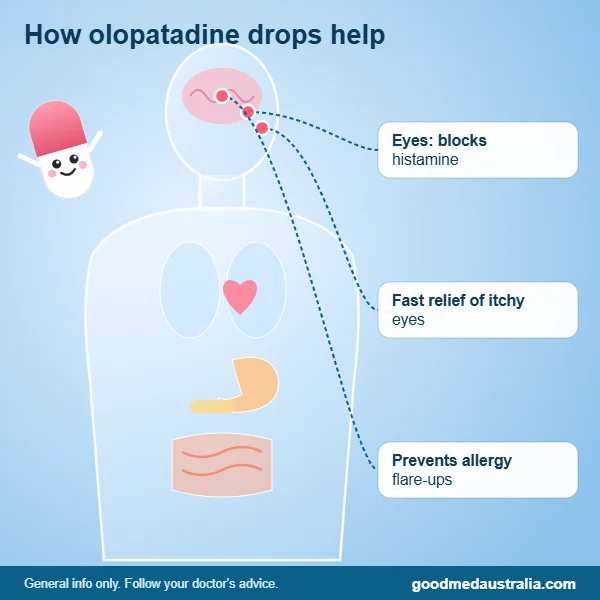
Allergic eye symptoms start when allergens meet mast cells in the tissue of the eye. Mast cells release histamine and other inflammatory chemicals, and these trigger the itch, redness and swelling. Olopatadine acts at two points in that chain.
- It blocks histamine H1 receptors. Olopatadine is a selective H1 antagonist, so it sits in the receptors on eye tissue that histamine would normally activate. This is the classic “antihistamine” action and is linked to relief from itching.
- It stabilises mast cells. It helps stop ocular mast cells from breaking open (degranulating) and releasing more histamine and inflammatory signals. In theory, this helps limit symptoms from returning.
That is why olopatadine is often described as a dual-action drop, and why the labels “antihistamine” and “mast cell stabiliser” both appear in discussions of it. Many web articles reduce it to “an allergy drop” and skip this detail.
Because the drop is applied directly to the eye, it acts on the site where symptoms occur. Oral allergy tablets work throughout the body instead. Whether a drop or a tablet suits you depends on your symptoms, and that is a question for a health professional.
Approved use, early research and traditional use
Evidence varies in strength, so it helps to see the categories side by side.
| Category | What it covers | Strength of evidence |
|---|---|---|
| Approved use | Signs and symptoms of seasonal allergic conjunctivitis (TGA-approved for olopatadine 0.1% drops) | Regulatory approval and clinical consensus |
| Early research | Possible secondary anti-inflammatory effects; higher-strength and nasal formulations studied overseas | Laboratory and preclinical studies; not a basis for everyday decisions |
| Traditional use | None. Olopatadine is a modern synthetic medicine | Not applicable |
What early research is looking at
Laboratory studies suggest olopatadine may do more than block histamine. In vitro work indicates it reduces expression of intercellular adhesion molecule-1 (ICAM-1) on conjunctival epithelial cells. Preclinical studies also report reduced production of inflammatory cytokines, such as TNF-alpha and interleukin-6, and of prostaglandin D2 in eye tissues.
These findings are interesting for scientists, but they come from lab and preclinical settings. They don’t change what the drop is approved for. Internationally, researchers have also looked at once-daily drops at higher concentrations (0.2% and 0.77%) and at a nasal spray. Availability varies by country and by what has been approved, so don’t assume a product seen overseas is available here.
The Australian context: a prescription medicine
Many online guides assume olopatadine drops can be picked up off the shelf, as in some other countries. In Australia, olopatadine 0.1% eye drops are Schedule 4 (Prescription Only Medicines). They are also not currently subsidised under the Pharmaceutical Benefits Scheme (PBS).
In practice, this means a prescriber needs to be involved. If you have itchy, red eyes and don’t know why, a GP, optometrist or pharmacist can help work out the likely cause first. Red eyes can have several causes, and an allergy drop only makes sense if allergy is the right explanation.
Contact lenses: a practical example
Picture someone who wears soft contact lenses and gets itchy eyes whenever grass pollen is high. The lenses make things more complicated.
Olopatadine drops contain benzalkonium chloride, a preservative. Soft contact lenses can absorb it, and this may irritate the surface of the eye. For this reason, the guidance is to take lenses out before the drops go in and to wait at least 15 minutes before putting them back. Many sources simply say “avoid contacts”, which leaves out the reason and the waiting time.
Check the product information and ask your pharmacist or optometrist how this applies to your type of lens. Many lens wearers also find that itchy eyes are a good reason to review their lens routine with an optometrist.
Side effects and how long to use them
Common mild effects include:
- stinging or irritation in the eye
- dry eyes
- temporary blurred vision
- headache
- an unusual taste in the mouth (dysgeusia)
Blurred vision matters if you are about to drive or do something that needs sharp sight. Speak to your doctor or pharmacist if symptoms are bothersome, don’t settle, or get worse.
On duration, “use it as long as needed” is too vague. Continuous use has been studied in clinical settings for up to 14 weeks, under supervision. If symptoms last a whole hay fever season or keep returning, that is a reason for a review with an eye health professional rather than open-ended self-management. Your prescriber will set the directions that apply to you.
Frequently asked questions
Is olopatadine an antihistamine?
Yes, but not only. It blocks H1 histamine receptors and also stabilises mast cells, so it is often described as having a dual action.
Can I buy olopatadine eye drops without a prescription in Australia?
No. Olopatadine 0.1% eye drops are Schedule 4 and need a prescription. They are not currently on the PBS.
Can I use them with contact lenses?
The preservative benzalkonium chloride can be absorbed by soft lenses. Lenses should be removed before the drops and reinserted no sooner than 15 minutes afterwards. Confirm this against the product information and with your pharmacist or optometrist.
Do they treat all red eyes?
No. Their approved use is for the signs and symptoms of seasonal allergic conjunctivitis. Red or irritated eyes can have other causes, so get them assessed if you are unsure.
How long can they be used?
Clinical use has been studied for up to 14 weeks under supervision. Anything beyond a short course should be reviewed by a health professional.
The takeaway
Olopatadine eye drops work by blocking histamine receptors and calming mast cells, which fits the way allergic eye symptoms develop. In Australia they are a prescription medicine with a specific approved use, some practical cautions for contact lens wearers and a studied duration limit. The laboratory findings on inflammation are interesting but remain early research.
If your eyes are itchy, red or watery, speak to your GP, optometrist or pharmacist. They can confirm the cause and advise whether olopatadine, or something else, is appropriate for you.
Related guides
- Dry Eyes in Australian Climates: Relief & Causes
- Conjunctivitis: Symptoms, Treatment and When to See a Doctor
- Stye Treatment: Symptoms, Home Care and When to See a Doctor
Find more trusted, plain-English health guides at goodmedaustralia.com.