
Sorry, nothing in cart.
Blog

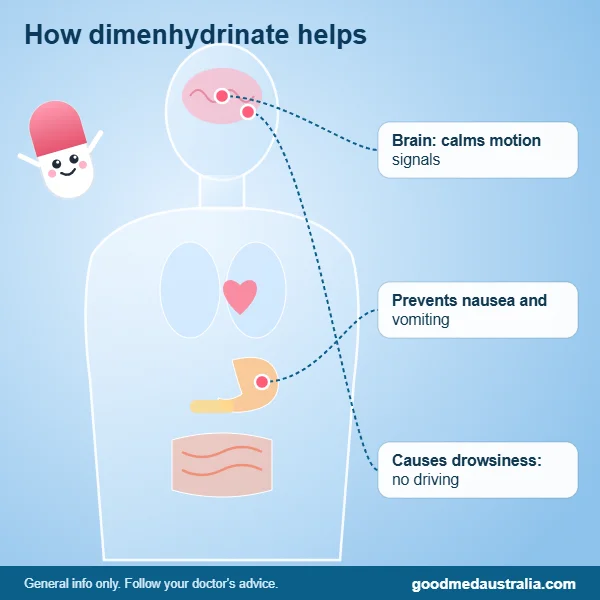
Most people only think about motion sickness medicine at the worst moment: the car park before a long drive, the ferry terminal, or the departure gate with a child who gets queasy on winding roads. Dimenhydrinate is one of the older options on the pharmacy shelf. It’s well established, but it’s also a sedating antihistamine, so the side effects deserve as much attention as the benefits.
What dimenhydrinate is approved for
Dimenhydrinate is a first-generation sedating antihistamine. Regulators including the Therapeutic Goods Administration (TGA) have approved it for the prevention and symptomatic relief of motion sickness: nausea, vomiting and dizziness. In Australia it is a Schedule 2 Pharmacy Medicine.
It works by blocking histamine (H1) and muscarinic acetylcholine receptors in the brain’s vestibular system. That dampens the conflicting signals sent when your inner ear senses movement but your eyes, say, are fixed on a book or phone screen.
Prevention works better than rescue
This is the point many articles blur. Antihistamines like dimenhydrinate are approved mainly for prevention and are most effective when taken 30 to 60 minutes before motion begins. A 2022 Cochrane review found that sedating antihistamines reduce the risk of motion sickness symptoms in adults under natural motion conditions. The same review found that high-quality evidence is lacking for treating symptoms after they have already started.
So if you’re already nauseated mid-journey, don’t assume a tablet will turn things around. The evidence supports planning ahead.
What you’re likely to find in Australia
Much online information comes from the US, where single-ingredient products such as Dramamine are common. In Australia, dimenhydrinate is often found in combination products. TravaCalm Original, for example, combines dimenhydrinate, hyoscine hydrobromide and caffeine.
The caffeine isn’t a quirk. Chemically, dimenhydrinate is a 1:1 salt of diphenhydramine (the antihistamine) and 8-chlorotheophylline, a stimulant related to caffeine that offsets some of the sedation. Combination products add further caffeine for the same reason. Even so, don’t assume a formulation is non-drowsy. Hyoscine and diphenhydramine both have effects of their own, so read the label and ask your pharmacist how a specific product is likely to affect you.
Common side effects
Because dimenhydrinate acts on the brain and blocks acetylcholine, the side effects are predictable:
- Drowsiness and sedation
- Dry mouth
- Blurred vision
- Dizziness
- Impaired psychomotor coordination (slower reactions and clumsier movement)
The last one matters most in practice. You can feel only mildly tired and still be less coordinated than usual.
Who needs extra caution
Some groups should be especially careful, and a pharmacist or doctor is the right person to ask.
Children
Evidence for use in children remains limited. In some young children, first-generation antihistamines can cause the opposite of sedation: hyperactivity and restlessness, known as paradoxical central nervous system excitation. A child who becomes wired rather than sleepy after a medicine like this isn’t necessarily “just excited”, so check with a health professional beforehand.
Adults over 65
Older adults face a higher risk of confusion, falls and anticholinergic side effects such as dry mouth and blurred vision. A medicine that makes a younger person pleasantly drowsy may affect an older person’s balance and thinking much more.
People with existing conditions
Caution is advised for people with narrow-angle glaucoma, severe asthma, chronic bronchitis, or urinary retention or an enlarged prostate. If you have any of these, don’t self-select a product without advice.
Pregnancy and breastfeeding
These are common questions, and they’re best answered individually by a doctor or pharmacist who knows your circumstances.
Alcohol, sedatives and driving
Dimenhydrinate must not be combined with alcohol or other central nervous system depressants, because the sedating effects can add up. If you’re affected by drowsiness, don’t drive or operate machinery.
Consider two ordinary situations. Someone planning to drive after a boat trip needs to think about how they’ll feel afterwards, not just on the water. Someone looking forward to a drink on holiday needs to check first, because a few drinks and a sedating antihistamine is a poor combination.
Evidence, history and traditional use
It helps to keep three categories separate.
| Category | What it covers |
|---|---|
| Proven and approved | Prevention and symptomatic relief of motion sickness, with the strongest evidence for prevention in adults |
| Historical and early research | Discovery and early trials in the late 1940s |
| Traditional or off-label | Use for vertigo linked to inner ear disorders such as Ménière’s disease, which needs medical consultation |
The history is a good story. Between 1947 and 1949, Drs Leslie Gay and Paul Carliner at Johns Hopkins Hospital were testing a compound (“Compound 1694”) for hives when a patient noticed that her streetcar motion sickness had disappeared. In 1948, a trial aboard the US troopship USS General C. C. Ballou showed significant protection against seasickness compared with placebo.
Off-label use for vertigo is a different matter from approved use. It’s something to discuss with a doctor, not a reason to reach for travel sickness tablets.
FAQ
Can I take it once I already feel sick?
It’s approved mainly for prevention. Evidence for relieving symptoms once they’ve begun is much weaker.
Is it the same as TravaCalm Original?
Not exactly. TravaCalm Original contains dimenhydrinate, but it also contains hyoscine hydrobromide and caffeine.
Will the caffeine stop me feeling drowsy?
Don’t count on it. Caffeine is included partly to offset sedation, but you shouldn’t assume you’re safe to drive. If you feel drowsy, don’t.
Is it suitable for young children?
Evidence in children is limited, and some develop restlessness or hyperactivity instead of drowsiness. Ask a doctor or pharmacist first.
The bottom line
Dimenhydrinate is a legitimate, approved option for preventing motion sickness, but it’s a sedating medicine that suits some people better than others. It works best when planned in advance, and it carries real risks for older adults, young children and people with certain conditions. Before you travel, speak to your doctor or pharmacist about whether it’s appropriate for you and which product, if any, fits your situation.
Find more trusted, plain-English health guides at goodmedaustralia.com.