
Sorry, nothing in cart.
Blog

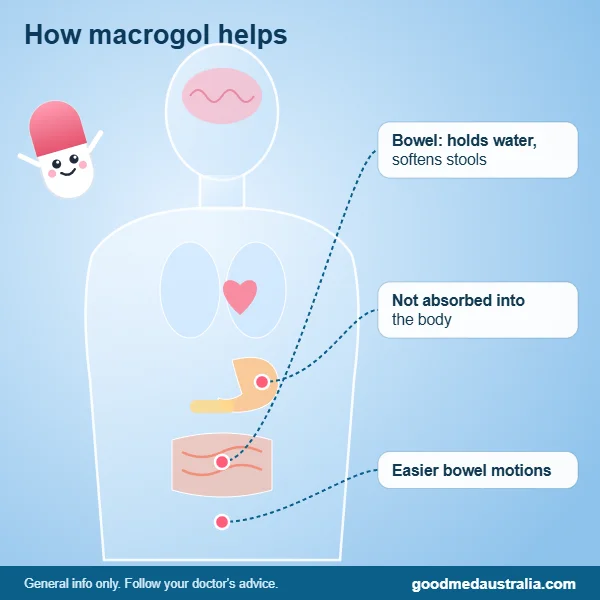
Most people who reach for a laxative want to know two things: what it is actually doing inside the bowel, and whether it is safe to keep using. Macrogol, also called polyethylene glycol or PEG 3350, is one of the most widely used options in Australia, yet it is often described in a single line as “a stool softener”. The mechanism is more interesting than that, and the safety details matter more than most short summaries suggest.
What macrogol is, and how it works
Macrogol is a synthetic, inert polymer. It is an osmotic laxative, which means it works by holding onto water. The large molecules are not absorbed, so they carry the fluids you drink into the large bowel. That extra water rehydrates hard stools and helps restore normal bowel movement.
This is the key difference from stimulant laxatives. Stimulants act on the nerve endings in the gut wall to trigger contractions. Macrogol does not stimulate those nerves. It changes the water content of the stool instead.
Traditional use, early research and approved uses
Laxatives have a long history, so it helps to separate what is traditional, what is early evidence and what is formally approved. The table below keeps those categories apart.
| Category | What it means for macrogol |
|---|---|
| Traditional use | Macrogol has no traditional use. Botanical stimulants such as senna and cascara have long been used for gut stimulation. Macrogol is a synthetic polymer introduced in the late 20th century as a non-irritating, non-absorbable way to keep water in the bowel. |
| Early research | Clinical studies in the 1990s found that high-molecular-weight polymers like macrogol 3350 pass through the human gut virtually unabsorbed and unfermented by gut bacteria. This is thought to avoid the extra gas and cramping associated with fermentable sugars such as lactulose. |
| Approved uses (Australia) | Macrogol products are registered on the Australian Register of Therapeutic Goods (ARTG) for short-term and chronic constipation. They are also registered for medically supervised management of faecal impaction and for bowel preparation before colonoscopy. |
The early research on gas and cramping is a useful comparison point, but it describes how the molecule behaves, not a guarantee of how any one person will feel.
Electrolytes or no electrolytes?
Australian macrogol products fall into two broad groups, and the difference is easy to overlook.
- With electrolytes. Some formulations, such as Movicol and Molaxole, contain added sodium chloride, sodium bicarbonate and potassium chloride. These help maintain the body’s salt and fluid balance when larger fluid shifts are involved, such as during impaction management.
- Without electrolytes. Electrolyte-free powders, such as OsmoLax, offer a similar stool-softening action and have a more neutral, unflavoured taste.
Brand names here are examples only, not recommendations. The practical point is that the two types are not identical, and the right fit depends on the person’s health and circumstances. A pharmacist can explain which type a given product is.
The sodium issue many articles skip
Because electrolyte-containing sachets include sodium, they add a sodium load. For most people this is unlikely to be a concern. For someone on a restricted-sodium diet, or living with heart failure or impaired kidney function, it may be an important consideration. If any of those apply, check with a doctor or pharmacist before using a product with added electrolytes.
Who should not use macrogol
Macrogol is generally regarded as non-habit-forming, but it is not suitable for everyone. It is strictly contraindicated in people with:
- intestinal obstruction
- gut perforation
- severe inflammatory bowel conditions, such as Crohn’s disease or ulcerative colitis
- bowel paralysis
In these situations, adding something that increases the volume of fluid in the bowel could be harmful. That is why new or unexplained bowel symptoms are worth having assessed before any laxative is started.
Common side effects
Mild effects are the usual ones: bloating, wind, nausea, abdominal discomfort and loose stools. Because macrogol works by drawing water into the bowel, looser stools are an expected effect of the way it works, not necessarily a sign that something is wrong. Persistent or severe symptoms should be discussed with a health professional.
Why the mixing instructions matter
Advice online often says to “mix it with any drink”. The more careful approach is that the powder should first be fully dissolved in plain water, following the product’s instructions. Flavourings such as fruit juice or milk can be added afterwards if the label allows it. Dissolving it in plain water first matters because the molecules need to bind with the water before anything else is added. The exact amounts and directions belong on the product label or with your pharmacist, and this article does not cover them.
Practical examples: when to get advice
- Constipation that has lasted more than two weeks. A persistent change like this should be assessed by a doctor or pharmacist before it is managed with ongoing laxatives.
- Severe abdominal pain or bleeding. These are reasons to seek medical advice promptly rather than self-manage.
- Heart, kidney or inflammatory bowel conditions. Tell your pharmacist before starting a macrogol product, particularly one with electrolytes.
- Pregnancy, breastfeeding or giving a laxative to a child. The research reviewed for this article does not give specific guidance, so ask a doctor or pharmacist about your situation.
FAQ
Is macrogol habit-forming?
It is generally considered non-habit-forming, because it does not stimulate the gut nerves. Anyone using a laxative regularly should still have the reason for that reviewed by a doctor or pharmacist.
How quickly does it work?
Timing varies between products and people, and the research here does not give a reliable figure. The product information or a pharmacist can explain what to expect for a specific product.
How is it different from lactulose?
Both are osmotic laxatives. Early research found that macrogol is largely unfermented by gut bacteria, whereas lactulose is a fermentable sugar linked to more gas and cramping.
Can I use it for as long as I like?
Do not decide that alone. Long-term use is a question for your doctor or pharmacist, who can consider your health history and the underlying reason for the constipation.
Conclusion
Macrogol works by holding water in the bowel, not by irritating the gut wall, and that distinction explains much of its reputation. It has approved uses in Australia, a straightforward mixing method and a generally mild side-effect profile. It also has firm exclusions, a sodium consideration with electrolyte formulations and clear points at which self-management should stop. Before starting, changing or stopping any laxative routine, or if bowel changes persist, speak to a registered doctor or pharmacist.
This article is for general education only and is not a substitute for personal medical advice.
Find more trusted, plain-English health guides at goodmedaustralia.com.