
Sorry, nothing in cart.
Blog

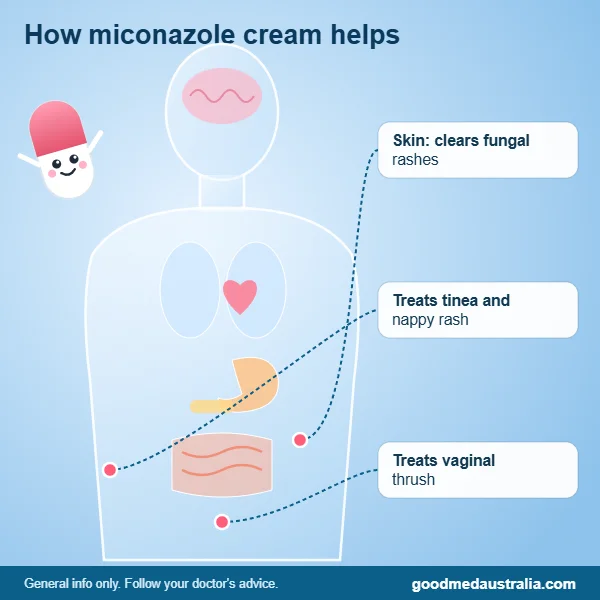
A red, itchy patch between the toes, a ring-shaped rash on the arm, or a nappy rash that won’t settle: it’s easy to assume these are all the same problem. They aren’t, and that is why miconazole cream sits behind the pharmacy counter in Australia rather than on an open shelf. This guide explains what miconazole cream Australia pharmacies supply is approved for, how it differs from other forms, and what to know about safety before you ask a pharmacist about it.
What miconazole cream is
Miconazole belongs to the imidazole class of synthetic antifungals. It works by inhibiting the production of ergosterol, a component of fungal cell membranes, which weakens the structure of the fungus. In Australia, the Therapeutic Goods Administration (TGA) has approved 2% miconazole nitrate dermal cream for topical use on certain fungal skin infections.
It is also a Schedule 2 (Pharmacy Medicine). That means you can get it from a pharmacy without a prescription, but only after talking with a pharmacist.
Proven and approved uses in Australia
These are the uses recognised by the TGA. They are the firmest part of the evidence picture, because they reflect regulatory approval rather than early research or tradition.
- Tinea (ringworm-type infections): athlete’s foot (tinea pedis), jock itch (tinea cruris) and body ringworm (tinea corporis).
- Pityriasis versicolor: a skin infection caused by Malassezia (Pityrosporum) yeasts.
- Candidal skin infections: external genital thrush, cutaneous candidiasis and thrush-infected nappy rash.
- Mild seborrhoeic dermatitis: where it is associated with Pityrosporum organisms on the face and body, excluding the scalp.
The seborrhoeic dermatitis indication is often overlooked. Plenty of overseas articles skip it, yet it is part of the Australian approval. The “excluding the scalp” detail matters too, because dandruff-type problems on the scalp are a separate question for a pharmacist.
Why the diagnosis matters
An approved list is useful only if the rash is actually one of those conditions. Many skin problems look alike. A scaly groin rash might be jock itch, but it could be something else entirely, and a cream chosen on a guess may do nothing useful.
Consider two ordinary situations. A parent notices a persistent nappy rash and wonders whether it is thrush. Or someone has itchy, peeling skin between the toes after weeks of wearing sweaty shoes. In both cases a pharmacist can ask the right questions, look at the skin and say whether an over-the-counter antifungal is reasonable or whether a doctor should see it. If a rash doesn’t improve, keeps returning or spreads, that is a reason to see a doctor.
General hygiene also plays a part in fungal skin problems. Keeping the skin clean and dry is the usual advice, and your pharmacist can tell you what else is relevant to your situation.
Topical cream versus oral gel
Miconazole comes in more than one form, and the safety considerations differ. The cream is applied to the skin and absorption into the body is minimal. Oral gels are a different product. They carry specific choking precautions in infants and a higher risk of systemic interactions. Don’t swap one form for another because they share an ingredient, and ask a pharmacist if you are unsure which product suits the problem.
Common side effects
The most commonly reported side effects of the cream are mild and local to the area where it is applied:
- itching
- stinging or burning
- mild redness
Because these can resemble the original rash, it can be hard to tell irritation from the infection itself. If skin becomes more irritated after using a product, speak to a pharmacist or doctor rather than persisting.
The warfarin interaction
This is the point most consumer articles leave out. Only small amounts of miconazole are absorbed through the skin, so it is easy to assume a cream cannot interact with other medicines. Case reports and clinical studies, including material published in the British Medical Journal and Australian Prescriber, suggest otherwise in at least one important case. Miconazole can inhibit the liver enzyme CYP2C9, and in rare cases even topical or vaginal use has been reported to interact with oral anticoagulants such as warfarin. The potential result is a raised INR and an increased risk of bleeding.
This is evidence from case reports and clinical studies rather than a reason for alarm, but it is clinically relevant for older adults and anyone taking a blood thinner. If you take warfarin, tell the pharmacist before buying any miconazole product, and mention all your medicines, including other creams and gels.
Pregnancy and breastfeeding
Miconazole cream is generally considered low-risk in pregnancy when used as directed. Even so, anyone who is pregnant or breastfeeding should confirm suitability with a doctor or pharmacist first, particularly if the infection is in a sensitive area or the product will be used for longer than expected.
Evidence at a glance
| Category | What applies to miconazole |
|---|---|
| Approved use | TGA-approved 2% dermal cream for tinea, pityriasis versicolor, candidal skin infections and mild seborrhoeic dermatitis (not the scalp) |
| Research and safety reports | Case reports and clinical studies on CYP2C9 inhibition and warfarin interaction, including rare reports with topical or vaginal use |
| Traditional use | None. Miconazole is a synthetic antifungal developed through modern pharmaceutical chemistry in the late 20th century, with no traditional, indigenous or herbal history |
Frequently asked questions
Do I need a prescription for miconazole cream in Australia?
No. It is a Schedule 2 Pharmacy Medicine, available from a pharmacy after a conversation with the pharmacist.
Is miconazole cream used for nappy rash?
It is approved for thrush-infected nappy rash, not for every nappy rash. Nappy rash has several causes, so ask a pharmacist or doctor to help work out which type you are dealing with.
Can I use it on my scalp for dandruff?
The seborrhoeic dermatitis approval covers the face and body, excluding the scalp. Ask a pharmacist about suitable options for the scalp.
Is a herbal or traditional version available?
Miconazole has no traditional or herbal history. It is a modern synthetic medicine, so anything described as a traditional form of it should be treated with caution.
The takeaway
Miconazole cream has clear, TGA-approved uses for several fungal skin conditions, and its common side effects are mild and local. The details that matter most are the ones that get missed: the Schedule 2 status, the difference between cream and oral gel, and the warfarin interaction. Before using it, speak to a pharmacist or doctor, especially if you are pregnant, breastfeeding, giving it to a baby, taking a blood thinner, or dealing with a rash that isn’t clearing up. This article is general education and does not replace individual advice.
Related guides
- Clotrimazole Cream: Uses, Safety and How It Works
- Terbinafine Cream: Uses, How Fast It Works
- Ketoconazole Shampoo in Australia: Facts
Find more trusted, plain-English health guides at goodmedaustralia.com.